
An onboarding knowledge gap is anything a new hire needs to do the job that they can only get by asking someone: the reason behind a step, the exception to a rule, who actually approves what. Most of it lives in people's heads, not in the handbook. The fix is to bring that missing context into a shared place where a new hire can search it on day one, and where it stays current as the work changes. That is the job we built Kept to do for your team.
TL;DR
- Gaps are rarely missing files. They are missing reasons, exceptions and decision rights that experienced people carry in their heads.
- New hires feel it fast: 39% say they had to work out some of their responsibilities on their own, and 25% say training did not cover every part of the job.
- Find gaps with a role-based knowledge map, 30/60/90-day check-ins and a log of the questions new hires keep asking.
- Close them by documenting the why next to the what, then having new hires practice and get feedback.
- Keep them closed by reviewing the material whenever the process changes, not once a year.
Table of Contents
- What an onboarding knowledge gap really is
- Signs your new hires are running into gaps
- Why gaps open up as a company grows
- How to find the gaps before your next hire does
- How to close the gaps: a practical sequence
- Remote and distributed teams
- Where the four C's fit
- What Kept does for onboarding
- Our perspective
- FAQ
- Sources
What an onboarding knowledge gap really is
Researchers who review the onboarding literature split what a new hire must learn into two kinds. Explicit knowledge is the written layer: regulations, training materials, job descriptions. Tacit knowledge is the decision-making routines and sequences of action that depend on context and are picked up mainly through practice, mentoring and shadowing. Gaps in the second kind are a distinct onboarding risk, and they are the ones a handbook does not fix.
Here is what that looks like on an ordinary Tuesday:
- A new coordinator asks why invoices over a certain size go to a second approver, and nobody wrote down the reason.
- A new hire follows the written process exactly, then learns that one major customer is handled differently.
- Someone needs a decision made and does not know whether they are allowed to make it.
In each case the document exists, or the process exists. The context does not. Systems hold the numbers, people hold the reasons, and nothing holds both.
Signs your new hires are running into gaps
You do not need a survey to see them. Watch for these patterns:
- Repeat questions. The same five questions reach your most experienced people every cohort.
- Slow independence. New hires still need a person beside them long after the training calendar says they should not.
- Escalation in both directions. Some new hires ask about everything, others decide things that were never theirs to decide. Both point to unclear decision rights.
- Conflicting answers. Two managers explain the same step two ways.
- Wrong or missed meetings and handoffs. Nobody told them which recurring touchpoints matter.
The numbers back the instinct. The same AIHR roundup reports that 24% of new hires did not know how quickly they were expected to learn their role. On the cost side, SHRM's onboarding guide cites a US and UK study estimating that businesses lose about $37 billion a year because employees do not understand their jobs, and treats role clarity as one of the better indicators of how well a new employee is adjusting.
Why gaps open up as a company grows
A study of a fast-growing, knowledge-intensive firm at Chalmers University in Sweden found that growth stretched the time it took new hires to become productive. Three things drove it: domain knowledge fragmented across teams, bonds between teams weakened so less knowledge moved, and work stayed informal, with little documentation and limited access to the people who knew things.
That pattern is familiar in any growing team. Every layer holds a different piece of how the company runs:
| Layer | What they hold | What they are missing |
|---|---|---|
| Leadership | Why: strategy and priorities | How the work really runs below them |
| Department heads | How departments connect | What happens on the ground |
| Managers | Who does what, and the judgment calls | Time, because they relay context all day |
| People doing the work | The daily practice | The reasons behind it |
The context that links these layers gets lost each time it passes from one person to the next. A new hire lands in the middle of that and has to rebuild it by asking around. Asking is not free: the socialization research notes that seeking information is inherently risky for newcomers, so some use subtle tactics rather than asking outright. Many gaps therefore never surface as questions at all.
A meta-analysis of 70 samples found that information seeking is positively related to role clarity and social acceptance, and that role clarity, self-efficacy and acceptance by colleagues carry the effect of onboarding on satisfaction, commitment, performance and turnover. Making answers easy to reach, without a new hire needing to feel they are interrupting someone, is part of closing the gap.
How to find the gaps before your next hire does
Build a knowledge map for each role
APQC recommends process- and role-based knowledge maps that show what knowledge a role requires, where it lives and how it moves. Pair that with a risk and gap analysis to see which critical knowledge is missing or stuck.
In practice, start small. Pick one role you hire for often and list:
- the five to ten recurring processes the role runs;
- for each one, who knows the exceptions and the reasons;
- where that knowledge is written down today, if anywhere.
Any process where the answer to the last question is "nowhere" is a gap.
Use 30/60/90-day check-ins to ask the right question
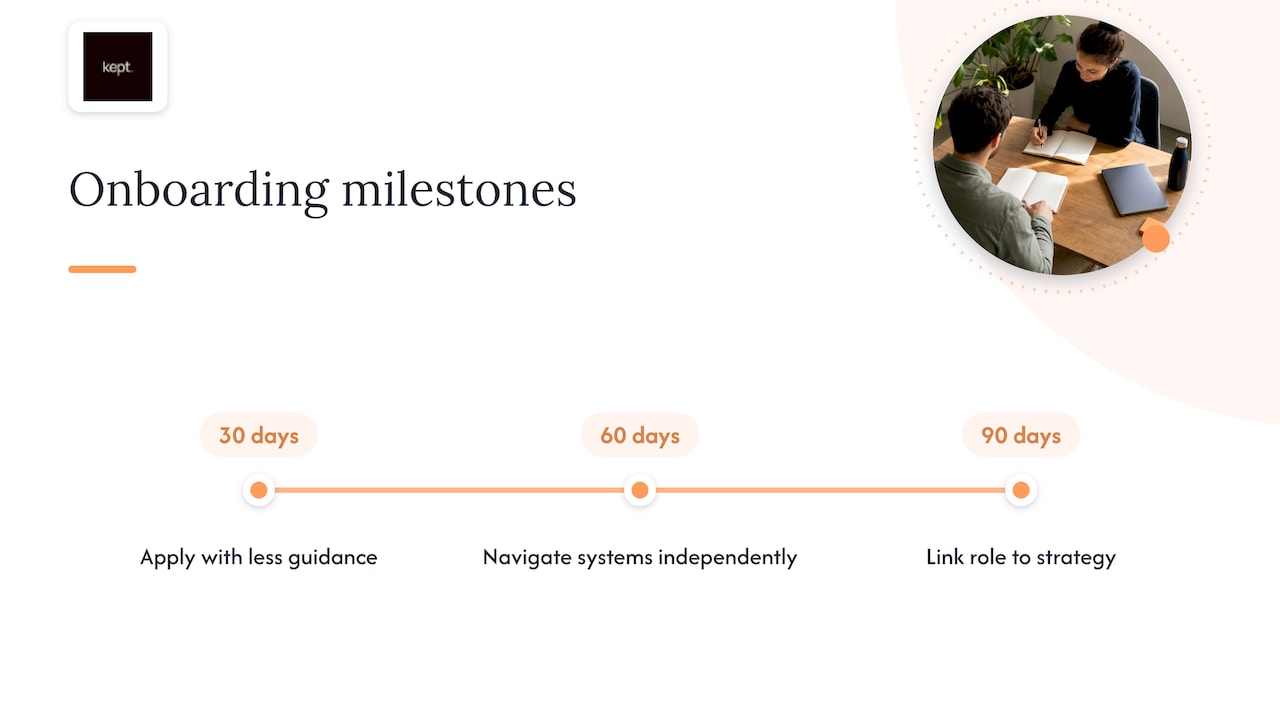
The University of South Carolina's onboarding guide frames 30, 60 and 90-day milestones: applying new knowledge with less guidance by 30 days, navigating systems and workflows independently by 60, and explaining how the role supports a strategic priority by 90. The useful part is the check-in question: what is still unclear, and where is more practice, context or training needed?
Write the answers down by role, not by person. Patterns across several hires show you where the material is thin. This is about the gaps in the process, never about ranking the people going through it.
Keep a log of repeat questions
Every question a manager answers twice is a candidate for a shared answer. A simple running list, tagged by process, gives you a prioritized to-do list for your documentation. Our guide to onboarding process documentation covers what to write and how for those entries.
Measure whether the gaps are closing
Most teams skip this. A Kronos and HRDA report found that 55% of organizations do not measure onboarding at all. Among those that do, the most common measures are employee satisfaction (28%) and one-year turnover (25%), while only 7% track time to role proficiency, even though 33% name shorter time to proficiency as a goal.
Time to proficiency is the measure closest to knowledge gaps, so it is worth adding. Define it per role, for example the number of days until a new hire completes a first independent task, and watch whether it shortens as you fill in the missing context.
How to close the gaps: a practical sequence
1. Document the why, not just the steps
A step list tells a new hire what to click. The reasoning tells them what to do when the situation does not match the list. For each process, record four things: what is done, why it is done that way, when that way applies, and who does it. Exceptions deserve the most care, because that is where judgment lives.
This is where a guided conversation beats a blank page. People rarely write down what feels obvious to them, but they will explain it when asked a good question. In Kept, you describe a process in your own words and a guided conversation draws out the exceptions and the reasoning, so the answer to "why do we do it this way?" is stored next to the step. A short exchange might go like this:
You: When we onboard a regional client, we skip the standard kickoff call.
June: Got it. When does that apply, and what do you do instead?
The answer becomes part of the process record, searchable by the next person.
2. Link each process to its owner and its systems
A process note that cannot be traced to a person or a system goes stale quickly. Name who owns each one, and connect it to the systems the work touches. Kept connects to the systems a company already uses, so the context sits alongside the work it describes. See how Kept works with the systems you already use.
3. Add the human transfer for deep expertise
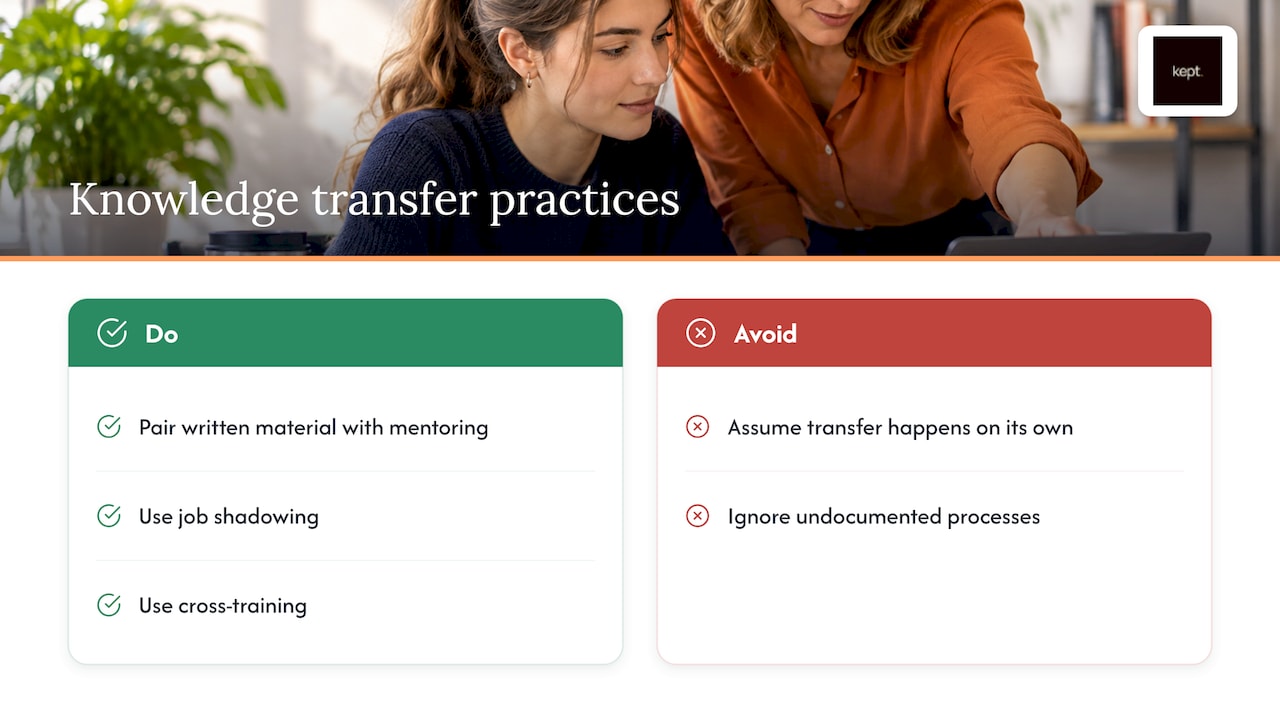
APQC is direct about the limit of paperwork: documentation alone may not preserve experience, judgment and context, so deep tacit knowledge often needs direct interaction. Pair written material with mentoring, job shadowing and cross-training. California's state HR guidance on knowledge transfer lists the same strategies and warns against assuming knowledge transfer happens on its own or ignoring undocumented processes.
The two work together. Recorded context lets mentors spend their limited time on judgment and coaching instead of repeating basics. When a key expert is about to move on, an expert handoff puts what they know where the next person can reach it, and our piece on tribal knowledge shows how to run a small pilot before it is urgent.
4. Let new hires practice and get feedback
Knowledge only counts when the recipient can apply it. APQC advises giving people room to ask questions, practice the work, receive feedback and demonstrate competency. A 2023 systematic review of five studies covering 1,556 new professionals found that structured, supported on-the-job training had the strongest evidence for helping newcomers adjust, with effect sizes between 0.13 and 1.35 in the studies that found a significant effect. The review rates the certainty of the evidence as low, which is a reason to measure your own results rather than assume them.
5. Give every new hire a documented learning path
APQC's research found that 94% of people with an ideal onboarding experience had a structured plan with a documented learning path, against 80% of everyone else. Those outside the ideal group were more likely to report working out their responsibilities alone, getting incomplete training, or finding the job different from its description. A learning path built from your role maps, with the why attached to each process, answers all three complaints. Our employee onboarding checklist for managers lays out a 90-day structure you can adapt.
6. Review when the work changes
Processes change and experts move on, so APQC says to review knowledge maps regularly. Tie reviews to events: a new tool, a policy change, a departure, a new customer segment. Each time a process changes, record why it changed. Our note on process version control explains how to keep the reasoning behind each version.
Remote and distributed teams
When new hires cannot lean over to a colleague, gaps stay hidden longer. Context has to be findable without a live conversation. The same principles apply: record reasons and exceptions, name owners, and give new hires a way to get an answer at any hour. For the process side, see our guide to asynchronous onboarding. Engineering teams have extra needs around code, tooling and architecture decisions, covered in engineering onboarding documentation.
Where the four C's fit
SHRM describes the four C's of onboarding as compliance, clarification, culture and connection. Knowledge gaps sit mostly in clarification, where the new hire learns what the job is and what is expected, and in connection, the information networks they have to build. A reasoned, searchable record of how work is done supports the first directly and shortens the path to the second, because the new hire knows who to go to about what.
What Kept does for onboarding
Kept brings your company's information into one place. It connects to your systems and talks with your people at every level, from leadership to the people doing the work, so what is done, why, when it applies and who does it is held together and linked to the systems and numbers that work touches. June, our AI companion, gives each person guidance and answers questions with citations to the underlying record, so a new hire sees where an answer came from.
Teams use workspaces with access controls, so you decide who sees what. Taking part is each person's choice, and nothing a team says is used to train AI. Kept never scores or ranks anyone: the aim is to show where the company does the same job in different ways, so the company can decide which way becomes its own.
If you are an HR lead or manager planning a pilot, the Kept for Business page shows how a business workspace is set up, and plans for individuals and businesses are on the pricing page.
If you would like a lighter first step, one team lead can start by documenting three to five processes in a personal knowledge workspace, and a broader pilot can follow in four to eight weeks.
Our perspective
Every company we talk to has the same quiet problem. The information is not missing. It is scattered across people who are too busy to repeat it. A new hire ends up as the connective tissue of the company for a few months, walking from desk to desk to rebuild context that already exists somewhere.
We think the answer is to hold the why together with the what, in the words of the people who do the work, and to make it available the moment someone needs it. When a manager answers a question once and that answer is kept, linked to the work and cited, the next new hire gets it without a meeting.
That is also why participation has to be a choice and why the record belongs to the team. People share context when they trust how it will be used. Our job is to make the knowledge easy to keep and easy to find, so your managers get their time back and your new hires get to useful work sooner.
Anthony
FAQ
What should be included in onboarding to avoid knowledge gaps?
Cover the four C's: compliance, clarification, culture and connection. Within clarification, give each role a documented learning path with the reasons and exceptions behind its key processes, named owners for each process, and a clear statement of what the person can decide alone. Add 30, 60 and 90-day check-ins to find what is still unclear.
What are the signs of bad onboarding?
Common signs are new hires who stay dependent on one colleague for months, the same questions reaching senior staff again and again, confusion about who decides what, and people missing meetings they should attend. Survey data shows the same thing from the new hire's side: AIHR reports that 39% had to find out some responsibilities independently.
What is the 30-60-90 onboarding rule?
It is a three-stage plan. By 30 days the new hire applies what they have learned with less guidance, by 60 they handle systems and workflows independently, and by 90 they can explain how their role supports a company priority. Use each checkpoint to ask what is still unclear, then fix the material, not just the person's questions.
How do I measure whether knowledge gaps are closing?
Track time to proficiency for each role, such as days until a first independent task, and compare cohorts over time. Add short check-ins at 30, 60 and 90 days and watch whether the same questions keep coming back. A falling count of repeat questions is a practical sign that the shared record is filling in.
Sources
- 27+ Employee Onboarding Statistics, AIHR
- Maximizing Success, SHRM onboarding guide
- SHRM onboarding guidance on the four C's
- Sustainable HRM in onboarding: the role of tacit knowledge, Journal of Management Development
- Onboarding employees in a fast-growing organization, Chalmers University
- Effective New Employee Socialization
- Newcomer Adjustment During Organizational Socialization, meta-analytic review
- How Can Knowledge Practices Improve Onboarding and Offboarding, APQC
- How to Improve the Employee Onboarding Process, APQC
- University of South Carolina Employee Onboarding Guide
- Competency Models and Knowledge Transfer, California HR
- Effectiveness of formal onboarding for facilitating socialization, systematic review
- New Hire Momentum: Driving the Onboarding Experience, Kronos and HRDA