
Process version control is the discipline of tracking, storing, and restoring the different iterations of your SOPs and workflows, including the reasoning behind each change, not the code repositories most search results assume. The immediate move: start a single versioned repository that records every revision alongside its rationale and links directly to onboarding materials. Tools like Kept build that repository from conversational capture instead of static documents.
TL;DR:
- Most teams should prioritize capturing rationale alongside process changes to ensure onboarding speed and safer rollbacks, not just maintaining latest versions.
- Implementing a structured repository with metadata, standardized templates, and access controls supports staff turnover and scales beyond individual habits.
- Embedding conversational capture sessions into regular meetings and using guided AI tools help preserve tacit knowledge and exceptions that static documents miss.
- Regular review of the revision logs and strict change gating are essential to prevent drift and ensure process integrity over time.
- Focusing on recording why changes happen, not just what changes, leads to better knowledge transfer and reduces long-term knowledge loss.
Table of Contents
- Why process version control matters for continuity and onboarding
- Core components of an effective process version control system
- How to roll out process version control on your team
- Policies for storing, auditing, and rolling back versions
- How Kept's conversational capture changes what "versioning" means
- What the research actually tells us to prioritize
- Where Kept fits if you're ready to start
- Sources
- FAQ
Why process version control matters for continuity and onboarding
Most companies lose process knowledge the same way: someone leaves, a handoff happens in a rushed meeting or not at all, and the next person inherits a document that tells them what to do but not why. Research on personnel transitions backs this up directly. Formalizing knowledge transfer with structured templates and guided interactions measurably reduces the knowledge loss that happens during handoffs, while unstructured transitions leave gaps that surface months later, usually at the worst time.
A structured transition process, built on templates and guided interviews, closes gaps that informal handoffs leave open, according to research on knowledge transfer during personnel transitions.
Rationale matters as much as the procedure itself. A revision log that only shows what changed, without saying why, tempts the next owner to roll back a fix that solved a real problem nobody remembers. When the "why" travels with the "what," onboarding gets faster and rollbacks get safer, because the person making the call has the same context as the person who made the original change.

Core components of an effective process version control system
A working version control system for SOPs needs more than a shared folder with dates in the filenames. It needs structure that survives staff turnover and scales past one team's habits.
- A versioned repository with time-stamped revisions and metadata showing what changed between versions, not just the latest state.
- Rationale capture attached to each atomic change, recording the reasoning, not only the edit.
- Standardized templates and a naming or version convention so every SOP looks the same regardless of who wrote it.
- Access control and audit trails that show who changed what and when, and who approved it.
- Integration points into onboarding, training, and ticketing systems so the version history actually gets used, not just stored.
- Change review gating, consistent with the planning-of-changes guidance in ISO documentation control standards, so no revision goes live without a second set of eyes.
That ISO guidance is worth taking seriously here. It recommends controlling documented information for availability, protection, and change history, treating a process document as an actively managed record rather than a static file.
Pro Tip: Capture rationale in the moment of change, not weeks later. Memory of "why" fades faster than memory of "what."
How to roll out process version control on your team
Rolling out version control across a team works best as a sequence, not a big-bang launch.
- Target the highest-impact, most tacit processes first. Rank workflows by how much would break if the one person who knows them left tomorrow.
- Structure the repository. Set up naming conventions, version numbers, and templates before you capture a single process.
- Schedule guided capture sessions. Book conversational interviews with the people who actually run the process, not just their managers.
- Embed capture into existing meetings. Add a five-minute "what changed and why" slot to a recurring team meeting instead of waiting for someone's exit interview.
- Assign owners, cadence, and approval rules. Someone needs to sign off on a new version before it replaces the old one.
- Train the team and wire it into onboarding. New hires should read the version history, not just the current SOP.
- Measure adoption and adjust. Track how often versions get updated versus how often work actually changes, and close the gap.
| Stage | Who owns it | What gets produced |
|---|---|---|
| Targeting | Team lead or ops manager | Ranked list of high-risk, high-tacitness processes |
| Structuring | Knowledge manager | Repository, naming convention, templates |
| Embedding | Everyone on the team | Recurring capture sessions, updated revision logs |
Structured handovers that capture tasks, decisions, resources, and contacts show what this looks like once it's running, rather than as a one-time project.
Policies for storing, auditing, and rolling back versions
A revision record earns its keep when someone needs to understand a change made a year ago. At minimum, each entry should include the author, the timestamp, a short diff summary, the rationale, and any related tickets or approvals. Skip any one of these and the record turns back into a mystery the next person has to solve from scratch.
- Retention and archival decisions should follow the same logic ISO applies to documented information: keep what preserves institutional knowledge, archive what's superseded, and delete only when there's a clear reason to.
- Immutable logs prevent quiet edits to history. Once a version is recorded, it stays recorded.
- Periodic review cadence catches drift before it becomes the norm; someone should check the log quarterly, not just when something breaks.
- Access logs show who viewed or changed a process, which matters as much for compliance as for troubleshooting.
- Rollback workflow should always include a test step: restore the previous version in a sandbox or trial run before it replaces the live SOP.
Rationale is easy to lose if you rely on diffs alone. Process-model research shows that recovering the reasoning behind a change after the fact is far harder than capturing it at the time, which is exactly why the rationale field can't be optional.
How Kept's conversational capture changes what "versioning" means
Kept builds the version history from guided conversation rather than from someone typing into a template after the fact. Employees describe their process in their own words, including the exceptions and judgment calls that never make it into a formal SOP, and that conversation becomes the structured record. Because the rationale is captured alongside the procedure, not reconstructed later, the next person reading version 4 understands why version 3 didn't work, not just that it changed.

That shortens the path to competence for a new hire and reduces misreads of old versions, particularly in RevOps handoffs and engineering continuity, where the reasoning behind a workaround often matters more than the workaround itself.
What the research actually tells us to prioritize
The instinct to treat process documentation like code, version numbers, diffs, a clean audit trail, is not wrong, but it's incomplete. Research on knowledge transfer mechanisms makes the case that codification alone underperforms for tacit knowledge. A repository without a human conversation behind it captures the rules and misses the judgment.
Where conventional advice falls short is in treating capture as a one-time event tied to offboarding. By the time someone's leaving, the rushed handoff has already started, and the best you can do is triage. NASA's own guidance leans the other way, recommending recurring knowledge-capture activities built into normal work, not saved for exits.
If you take one thing from this, prioritize the rationale field over the version number. A team that captures why a process changed, consistently, will outperform a team with a beautifully organized folder of SOPs nobody understands anymore.
— Anthony
Where Kept fits if you're ready to start
Most teams don't need a heavier document system. They need a way to get the reasoning out of people's heads and into a record before it walks out the door.
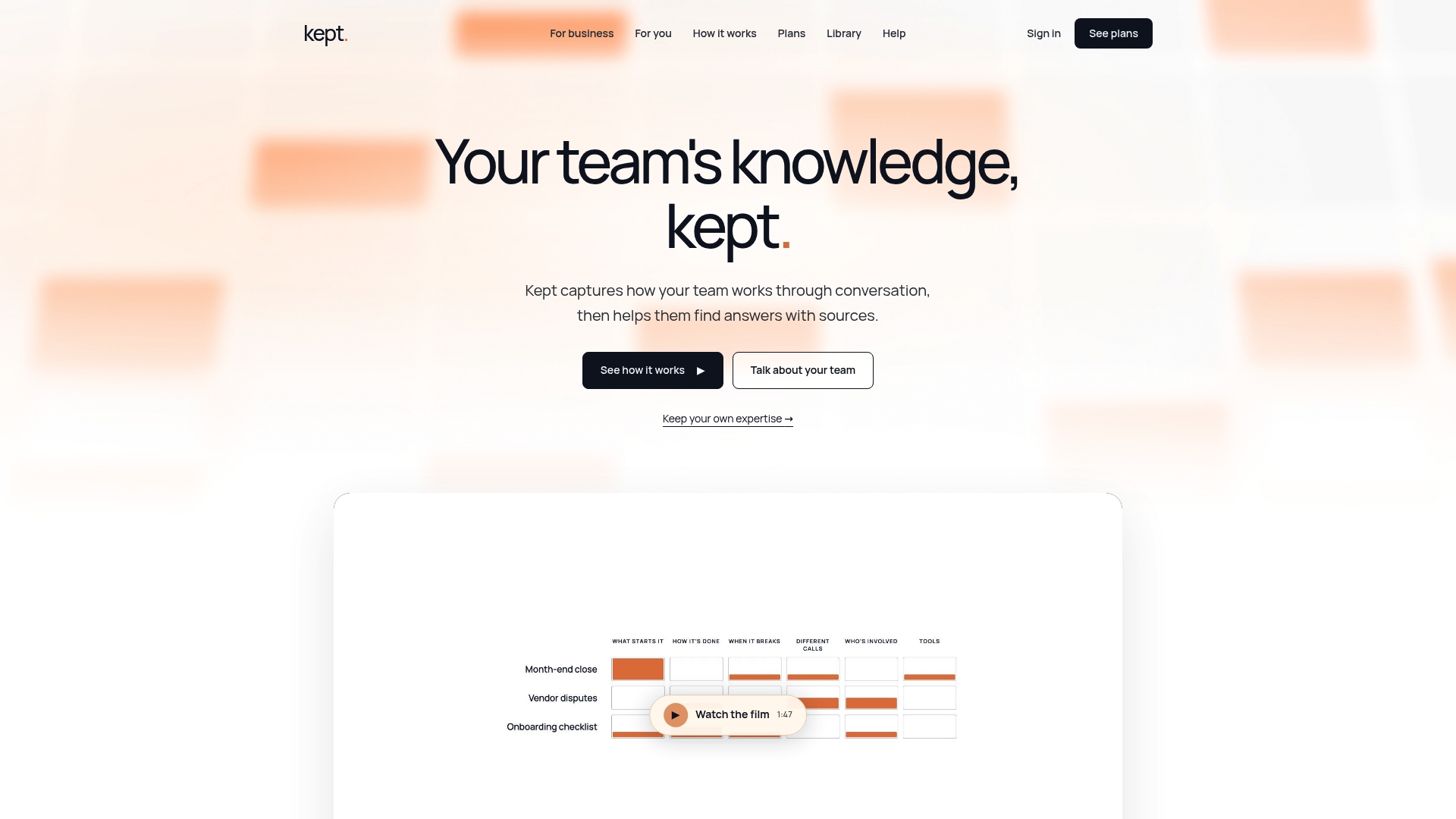
Kept does that through guided conversation instead of forms, which means the people who actually run a process can describe it the way they'd explain it to a new hire, exceptions included. That record becomes the versioned history your team refers back to.
- Offers capturing of individual expertise for personal continuity and career moves.
- Extends that to team workspaces with access controls, so knowledge stays with the organization rather than one person.
- Uses guided capture sessions that turn conversation into structured, searchable process documentation.
- Provides resources covering how data is handled, stored, and deleted for teams with governance requirements.
Operations managers tend to see the fastest return, since structured handovers cut the time a new hire spends guessing. Check pricing for Kept for You and Kept for Business to see which workspace fits your team.
Sources
- PMC article on knowledge transfer and transition practices
- Ensuring Knowledge Continuity during Employee Transitions (NASA report)
- Annual Reviews article on knowledge transfer mechanisms
- BS ISO 10013 / guidance on documented information
FAQ
What is the difference between process version control and document version control?
Process version control tracks the evolving reasoning and steps behind how work actually gets done, including exceptions and judgment calls, while document version control just tracks edits to a file. The distinction matters because a process can stay technically unchanged on paper while the real practice, and the reasoning behind it, shifts.
How often should a team update its process versions?
There's no fixed interval, but embedding capture into recurring meetings works better than waiting for major events. NASA's guidance recommends regular knowledge-capture activities rather than one-off sessions tied only to departures.
What should a minimum revision record include?
At minimum, record the author, the timestamp, a short summary of what changed, the rationale, and any related approvals or tickets. Skipping the rationale field is the most common mistake, since it's the piece hardest to reconstruct later.
Can conversational AI actually replace a written SOP?
It replaces the process of writing one from scratch by turning a spoken walkthrough into structured documentation, capturing exceptions and reasoning that a static template usually misses. Some conversational AI tools build this record from guided conversation so the resulting version history reflects how the work is actually done, not just how it's supposed to look on paper.
How do you roll back to a previous process version safely?
Test the restored version in a sandbox or limited trial before it replaces the live SOP, and check the rationale log to understand why the current version diverged from the one you're restoring. Skipping that check is how teams end up reintroducing a problem the earlier change was meant to fix.