
A complete employee onboarding checklist is a phase-based playbook that runs from preboarding through the first 90 days, pairing paperwork and IT provisioning with a manager-owned weekly coaching habit. The two priorities to fix first are compliance timing and manager ownership of the relationship once day one ends. Below is a checklist you can adapt now, along with 30/60/90 milestones built around what actually predicts retention.
TL;DR:
- Complete eligibility and tax documents on day one, then finish benefits forms and policy acknowledgments during week one to prevent paperwork delays from blocking training.
- Remote hires need equipment shipped at least five business days before the start date, plus setup instructions and a named IT contact available during week one.
- Managers should start weekly coaching focused on goals and blockers in week one, then review progress directly at 30, 60, and 90 days.
- Set written 30 day goals during the first week; track training completion, rework, and confidence at each checkpoint, and adjust missed targets promptly.
- For international hires, replace a single domestic handbook with core global policies and local addenda because employment rules differ by jurisdiction.
Table of Contents
- Phase-by-phase onboarding checklist from preboarding to 90 days
- New-hire paperwork and compliance: what to collect and when
- Access, equipment, and IT onboarding for in-office and remote hires
- Manager ownership, mentoring, and the weekly coaching habit
- Training, role clarity, and what to measure at 30, 60, and 90 days
- Tools, templates, and documenting onboarding workflows
- Common onboarding pitfalls and quick fixes
- Why manager-led onboarding and documented workflows win
- A faster way to turn onboarding knowledge into a reusable playbook
- FAQ
- Sources
Phase-by-phase onboarding checklist from preboarding to 90 days
Onboarding fails most often because it's treated as an event instead of a sequence. Each phase has a different job, and skipping ahead (handing someone a laptop with no context, or a mentor with no training plan) creates gaps that show up as confusion in week three.
Preboarding starts the moment the offer is signed, not the week before start date.
- Confirm signed offer letter and contract are on file.
- Send a welcome message with start date, schedule, and what to bring.
- Order equipment and schedule IT provisioning so devices arrive before day one.
- Block calendar time for orientation, manager welcome, and first-week meetings.
- Assign a mentor or buddy so the new hire has a named contact before they log in.
Day one is about orientation and belonging, not productivity.
- Walk through a clear agenda so the day doesn't feel improvised.
- Have the manager personally welcome the new hire, not just HR.
- Confirm workspace, account access, and login credentials work on the first try.
- Kick off benefits enrollment paperwork while it's fresh.
First week shifts from orientation to role clarity. This is when the new hire should understand what success looks like, not just where the bathroom is. Introductions to the immediate team and cross-functional contacts happen here, along with the first real training modules tied to the actual job. The manager and new hire should leave the week with a written set of 30-day goals, something specific enough that both sides could describe it the same way if asked separately.
First month moves into progressive training and the first formal check-in. This is where a 2025 study published in MDPI becomes relevant: the research found that onboarding's effect on retention runs through interpersonal connections and engagement, meaning the training content matters less than whether the new hire feels connected to people and clear on expectations. A 30-day review should cover both.
First 90 days is where onboarding either lands or quietly falls apart. This phase includes the 60-day check-in, the 90-day formal review, and a development plan that extends past onboarding into the next quarter. Treating 90 days as the finish line, rather than a checkpoint, is one of the more common mistakes we see in onboarding design; the goal isn't to finish onboarding by day 90, it's to have enough data by then to know whether it worked.
New-hire paperwork and compliance: what to collect and when
Paperwork delays are one of the easiest onboarding failures to prevent, and one of the most common. A missing tax form or an unsigned policy acknowledgment on day one creates a bottleneck that follows the new hire for weeks.
Core documents to track, organized by when they should be complete:
- Before day one: signed offer letter, signed employment contract, background check clearance (if applicable).
- Day one: tax withholding forms, employment eligibility verification, direct deposit authorization, emergency contact information.
- Week one: benefits enrollment paperwork, acknowledgment of policies and handbook, any role-specific certifications or licenses.
For eligibility verification specifically, the Federal Register published an update on optional alternatives to physical document examination for employment verification, which is worth reviewing if your process still assumes in-person document checks.
If you hire outside your home country, do not reuse a domestic checklist. SHRM advises against applying a single global handbook, recommending instead a minimal set of global policies plus localized addenda, since concepts like at-will employment don't translate across jurisdictions. A company hiring in Portugal, for instance, can lean on local employer-of-record guidance to understand onboarding timelines and compliance obligations that a U.S.-built checklist won't cover.

Access, equipment, and IT onboarding for in-office and remote hires
Nothing undermines a first day faster than a new hire staring at a laptop they can't log into. IT provisioning belongs in preboarding, not day one.
Checklist for IT and access setup:
- Order the device early enough to image, asset-tag, and test before shipping or deskside delivery.
- Enable multi-factor authentication before the account goes live.
- Grant SaaS and system access tied to role, not a blanket "new hire" template.
- Route access approvals through a named owner so nothing waits on an email thread.
- Confirm VPN and password manager setup, and have the new hire acknowledge the acceptable use policy.
Remote hires need extra lead time. Shipping a device internationally or across time zones can take longer than a local courier, so preboarding should start days earlier for remote roles. A virtual device walkthrough on day one, plus a named IT contact available during the first week, prevents a new hire from sitting idle while waiting on a support ticket.
Pro Tip: Ship remote equipment at least five business days before start date, and send setup instructions with it so the new hire isn't waiting on a call to get moving.
Manager ownership, mentoring, and the weekly coaching habit
HR builds the framework, but the manager owns the outcome. Once day one ends, onboarding success depends almost entirely on what the manager does next, not on how polished the orientation deck was.
Gallup's research on manager coaching found that a single meaningful, goal-oriented conversation per week between manager and new hire outperforms many of the standard onboarding extras. Gallup describes this as a kind of "silver bullet": not more training content, not a longer checklist, but a consistent weekly habit built around goals rather than status updates.
A manager's onboarding responsibilities, separated from HR's:
- Hold a 15 to 30 minute weekly coaching conversation focused on goals and blockers, not task lists.
- Review 30/60/90 progress directly with the new hire, not through a form alone.
- Make the first introductions to key stakeholders personally rather than leaving it to an org chart.
- Check in on the buddy or mentor relationship to confirm it's actually happening.
The 2025 MDPI study on onboarding and retention found that managers' welcome activities have a direct effect on retention, and that the shift from administrative onboarding to coaching needs to happen early. Waiting until the 30-day mark to start real coaching conversations is a common pitfall, and one that's easy to fix by scheduling the first one in week one.
A formal buddy or mentor program, assigned before day one and checked on by the manager, builds the interpersonal connections that the same research ties to lower turnover intention.
Training, role clarity, and what to measure at 30, 60, and 90 days
Role clarity means the new hire can describe their own success criteria without checking a document. That requires naming deliverables, stakeholders, and training milestones explicitly, not assuming they'll be absorbed through observation.
A practical structure for 30/60/90 goals:
- 30 days: core training modules completed, first small deliverable finished, confidence rating check-in with the manager.
- 60 days: independent ownership of a recurring task, stakeholder relationships established, mid-point review against original goals.
- 90 days: full role performance against defined success criteria, documented development plan for the next quarter.
Useful KPIs include time to complete required training, number of assigned tasks finished without rework, and a simple self-reported confidence rating gathered at each checkpoint. Document each review in writing, even briefly, so a missed milestone triggers a specific conversation rather than a vague sense that something's off. If a 30-day goal is missed, treat it as a signal to adjust the plan, not as a reason to wait and see what happens at 60.
Tools, templates, and documenting onboarding workflows
A checklist is only as good as the template behind it. An editable onboarding template should track, at minimum: the task, the owner, the deadline, evidence of completion, and a notes field for anything that doesn't fit the standard flow.
That notes field matters more than it looks. The exceptions, the judgment calls, the "we usually do it this way because of X" explanations, are exactly what gets lost when the person who trained the last three hires moves on. Research on onboarding and well-being treats onboarding as an extended process requiring manager ownership precisely because so much of it depends on context that a static document doesn't capture.
This is the part most checklists skip, and it's where documenting onboarding conversations directly earns its place. Capturing how a manager actually explains the role, in their own words, including the exceptions, turns a one-time training conversation into a reusable artifact for the next hire.
| What a static checklist holds | What a documented conversation adds |
|---|---|
| Task names and deadlines | The reasoning behind each task |
| Standard training modules | Role-specific exceptions and judgment calls |
| A generic 30/60/90 template | Context from the manager who's done it before |
- Fields worth tracking: owner, deadline, completion evidence, notes, follow-up items.
- A 4 to 8 week pilot can convert a handful of manager interviews into a searchable onboarding playbook.
Common onboarding pitfalls and quick fixes
Most onboarding breakdowns trace back to four repeat offenders: equipment that arrives late, expectations that stay vague past week one, a manager who disengages after day one, and paperwork that's still incomplete when training is supposed to start.
Fast fixes for each:
- Confirm preboarding paperwork and equipment orders in writing, not verbally, 48 hours before start date.
- Give managers a short playbook with weekly check-in prompts so coaching doesn't depend on memory.
- Set automated reminders for 30/60/90 reviews so they don't slip.
- Build a buddy checklist so the mentor relationship has structure, not just a name on a list.
Pro Tip: Collect new-hire feedback on the onboarding process itself at the 30-day mark; it's the fastest way to catch a gap before it repeats with the next hire.
Why manager-led onboarding and documented workflows win
The checklist matters, but it's not where onboarding succeeds or fails. We've seen plenty of well-designed checklists produce disengaged new hires because the manager treated day one as the finish line instead of the starting point. The weekly coaching habit is unglamorous, and it's the piece most likely to get dropped when everyone's busy, which is exactly why it deserves protection on the calendar.
The second piece we'd push harder on: document the reasoning, not just the steps. A checklist tells someone what to do. A recorded explanation of why tells the next hire what to do when the situation doesn't match the checklist exactly, which it usually doesn't.
Pilot this checklist with one team, track training completion time, 30-day confidence ratings, and manager check-in consistency, and you'll know within a quarter whether it's working.
— Anthony
A faster way to turn onboarding knowledge into a reusable playbook
If your team onboards similar roles repeatedly, or if the hardest part of training a new hire is capturing what the departing or senior person actually knows, a checklist alone won't solve that. We built Kept to let managers and experienced employees explain their work in conversation, in their own words, and turn that into structured, searchable documentation instead of a static manual.
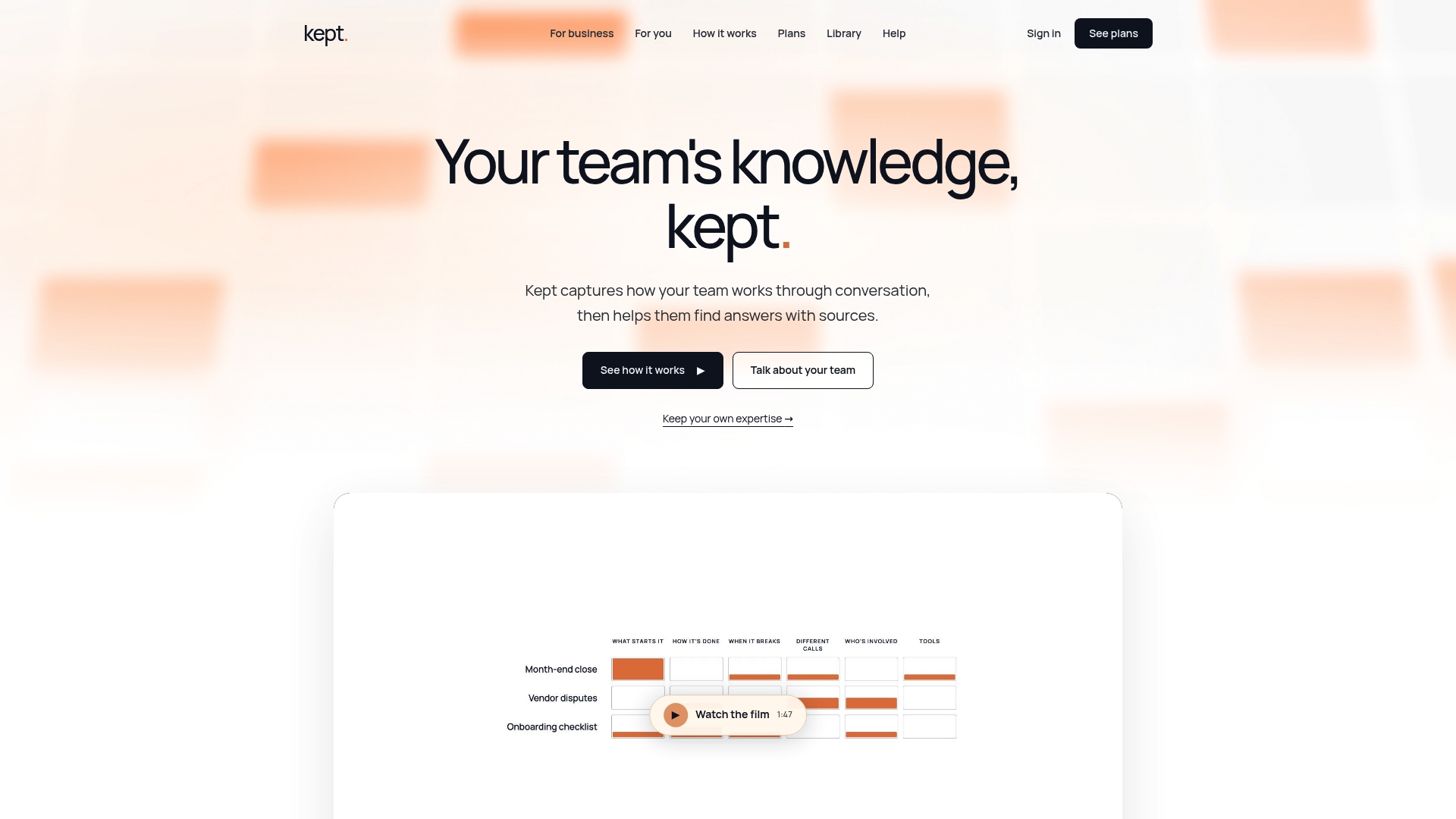
For onboarding specifically, that means a manager's explanation of "how we actually handle this exception" gets captured once and reused for every future hire in that role, not re-explained from scratch each time. A pilot through our onboarding use case typically runs four to eight weeks and produces a workspace built from real conversations rather than a template nobody updates.
Where this fits best:
- Teams that onboard the same roles repeatedly and keep re-explaining the same exceptions.
- Organizations with critical tacit knowledge held by one or two people.
- HR teams that want a documented playbook without asking managers to write one from scratch.
Review plans and pricing for kept for you and kept for business to see which fits your team's onboarding needs.
FAQ
What should be on an onboarding checklist?
A complete checklist covers preboarding paperwork, day-one access and orientation, first-week role clarity and introductions, and 30/60/90 milestones with manager check-ins built in. It should also include a named mentor or buddy and a feedback step to catch gaps early.
What are the 4 C's of onboarding?
The 4 C's commonly referenced in onboarding frameworks are compliance, clarification, culture, and connection, covering legal requirements, role expectations, organizational values, and relationship building. Different sources describe them with slightly different wording, but the core idea stays consistent: paperwork and role clarity alone aren't enough without culture and connection.
What are the four pillars of onboarding?
Definitions vary, but a common version names compliance, clarification, culture, and connection as the four pillars, closely mirroring the 4 C's framework. Some HR teams substitute "checklist" or "confidence" depending on their internal model, so it's worth confirming which version your organization uses before standardizing on one.
How long should employee onboarding take?
Onboarding is best treated as a 90-day process rather than a single orientation event, with research tying extended onboarding to better retention when managers stay involved throughout. Many organizations extend development planning beyond 90 days, but the first three months are where the core milestones and check-ins happen.
Sources
- Gallup Finds a Silver Bullet: Coach once per week
- The Invisible Bond: Onboarding and Talent Retention (MDPI, 2025)
- Viewpoint: Implement global policies, not a global handbook (SHRM)