
Tribal knowledge capture means turning the unwritten judgment calls, shortcuts, and decision rules your experienced people carry in their heads into something documented, retrievable, and owned by more than one person. The first move isn't buying software or scheduling interviews with everyone on staff. It's mapping where that tacit expertise actually lives and running a tight, focused pilot to prove the method works before you scale it.
TL;DR:
- Only 30% of organizations consistently capture retiring experts’ knowledge; lack of time (52%) and resources (45%) are the leading barriers.
- Use incident interviews to surface overlooked cues and rejected alternatives; sessions can run 15 minutes to two hours, then a second practitioner validates reasoning.
- Only 21% of organizations use AI to mine conversations; concerns include answer accuracy (46%) and data privacy and security (38%).
- Run a 4 to 8 week pilot across a handful of high risk processes, measuring onboarding time, retrieval accuracy, and incident resolution speed.
Table of Contents
- Why capturing tribal knowledge matters now
- Map where tacit expertise lives: inventory and exposure mapping
- Elicitation techniques that surface tacit judgment
- How to structure and store captured knowledge
- Practical tools and AI: what to automate, what to human-review
- Integrate capture into workflows and governance
- Prioritize and pilot: choosing the first projects and a realistic timeline
- Measure and maintain: metrics, audits and preventing staleness
- Practical templates and SME prompts to use today
- Leadership lessons from deploying capture programs
- How Kept turns conversations into structured, lasting knowledge
- FAQ
- Sources
Why capturing tribal knowledge matters now
We're in the middle of what many are calling the Great Retirement, and it's colliding with a real opportunity: AI tools that can finally make knowledge capture fast enough to matter. The risk is not abstract. When a senior technician, a longtime account manager, or a plant supervisor walks out the door, they take years of undocumented judgment calls with them, the kind that never made it into a procedure manual because nobody asked.
Only 30% of organizations consistently capture retiring experts' knowledge, according to APQC's Great Retirement survey, and the barriers are predictable: lack of time (52%) and insufficient resources (45%) top the list.
The operational fallout shows up as longer troubleshooting cycles, slower onboarding, and inconsistent decisions when the one person who "just knew" is gone. Teams that capture this knowledge well see the opposite: faster ramp-up for new hires, preserved judgment during handoffs, and decisions that hold up the same way whether the original expert is in the room or not.
Map where tacit expertise lives: inventory and exposure mapping
You cannot capture everything, and trying to is how these programs die. The smarter move is to find the handful of places where tacit knowledge is concentrated and risky, then start there.
Research on tacit knowledge as a competitive advantage makes a useful point: leaders should map where tacit knowledge resides and how it moves informally through a team before picking any technology or documentation format. Start with exposure points, not a blanket documentation mandate.
A few practical ways to find those exposure points:
- Ask managers directly who gets pulled into problems that nobody else can solve.
- Review incident logs and support tickets for recurring escalations that always land on the same person.
- Notice informal escalation routes: who gets a text message instead of a ticket when something breaks.
- Flag single points of failure, roles where one person's absence visibly slows the team down.
- Check onboarding feedback for new hires who say "nobody told me that" after a mistake.
Once you've spotted the hotspots, assign a steward to each one, usually the expert themselves or their closest backup, and record a rough exposure score: how often the knowledge gets used, how costly a gap would be, and how close the expert is to leaving or moving roles.
The deliverable here is not a full knowledge base. It's a short exposure map that ranks capture candidates by risk and impact. That map becomes the backlog for your pilot, and it keeps you from asking people to document things nobody actually needs.
Elicitation techniques that surface tacit judgment
Generic SOPs describe the official version of a process.
The fix is to ask about specific, difficult incidents instead of asking "what's the process." Research on cognitive task analysis found that asking someone about the last time something went wrong, and why, reveals the cues and pattern recognition a novice would miss, while asking for the general process tends to surface only the textbook answer.
A short sequence for running this kind of interview:
- Pick a real incident, ideally one that was nonroutine, difficult, or nearly went wrong.
- Reconstruct the timeline in the expert's own words, from first notice to resolution.
- Probe for perceptual cues: what did they notice that a less experienced person would have missed?
- Ask about alternatives considered and rejected, and the threshold that made them choose one path over another.
- Close by asking what would have changed their decision, and what a junior colleague would likely get wrong.
This structure borrows from the Critical Decision Method%20Critical%20Decision%20Method%20for%20Eliciting%20Knowledge.pdf), a semistructured retrospective interview technique that has been used in sessions as short as 15 minutes and as long as two hours, adapted to whatever time the expert has available.
Peer-driven methods work well alongside one-on-one interviews. Conspective, or collegial, verbalization has a peer watch a recording of the expert doing the task and narrate what's happening and why, which often catches details the original expert considered too obvious to mention. Workshops, shadowing sessions, and after-action reviews round out the toolkit, especially for knowledge that's more procedural than judgment-heavy.
Pro Tip: Always have a second practitioner review the captured reasoning before you publish it. One expert's account becomes a reusable reference case only after someone else confirms it holds up.
How to structure and store captured knowledge
A pile of interview transcripts is not a knowledge base. The structure you choose determines whether anyone finds the reasoning later, or whether it just becomes another folder nobody opens.
One useful approach borrows from fault tree analysis. Research on knowledge-structuring workflows describes using Reference Cases, or RCs, to anchor purpose-action pairs to observable outcomes, then linking those procedure-based entries to purpose-based nodes so the reasoning behind a decision stays traceable, not just the steps.
In practice, that means every captured asset should include:
- A reference case anchored to a real outcome: what happened, what was done, and why it worked.
- A clear purpose-action pairing, so the reader sees not just the step but the goal it served.
- Mandatory metadata: source, owner or steward, review date, and access scope.
- A link back to the related procedure document, so the "how" and the "why" stay connected instead of living in separate systems.
That last point matters more than it sounds. Organizational knowledge theory argues that structured knowledge only becomes useful when people can understand its context, challenge it, and connect it to authoritative material, not just retrieve a disconnected answer.
Governance is what keeps this from turning into a stale repository. Every asset needs an owner who validates it periodically, and a feedback path so the next person who uses it can flag when it's outdated. Without that loop, even a well-structured reference case can become quietly outdated.
Practical tools and AI: what to automate, what to human-review
AI is genuinely useful for the mechanical parts of capture: transcribing interviews, summarizing long sessions into readable drafts, extracting likely cues and decision points, and producing a first-pass template someone can edit rather than write from scratch. It is not yet a replacement for the validation step.
AI adoption for this work is still early and concern-driven. APQC's survey reports that only 21% of organizations currently use AI to mine conversations for reusable knowledge, while accuracy of AI-generated answers (46%) and data privacy and security (38%) are the top concerns holding adoption back.
The workflow that respects both the opportunity and the concern looks like this: capture the raw conversation, let AI produce a draft summary or structured template, then have the subject matter expert and a second reviewer validate it before anything gets published. Nothing goes live without a named owner, a review date, and a defined access scope attached. Workflow automation platforms like SmartFlowCRM show how this kind of staged, human-reviewed handoff can sit inside broader business processes rather than as a standalone step.

Integrate capture into workflows and governance
Capture programs that live as side projects tend to die quietly once the person who championed them moves on. The ones that last are built into how the team already operates.
That starts with ownership. Every critical knowledge area needs a named steward, and capture should be part of succession planning, not something that happens only during an exit interview. APQC's research notes that knowledge loss concern is widespread, but consistent capture is rare, which suggests the gap is less about awareness and more about treating it as routine work.
Build this into the rhythm of the team:
- Assign a steward to each high-risk knowledge area and name them in succession plans.
- Set a regular review cadence, with a visible due date on every asset.
- Recognize contributions publicly rather than treating capture as an unpaid extra task.
- Tie captured knowledge to a business metric, like onboarding time or incident resolution, so leadership keeps funding it.
Skills-first workforce planning tools, like the approach described in RecrutFlo's guide to talent pool management, offer a useful parallel: knowledge capture works best when it's linked to the same succession and skills data HR already tracks, not managed as a separate initiative.
Prioritize and pilot: choosing the first projects and a realistic timeline
Pick your pilot from the exposure map, not from whoever volunteers first. The right candidates sit at the intersection of high exposure and high business impact: a critical piece of equipment with one qualified operator, a process behind frequent incident tickets, or the account manager handling your most demanding client.
A workable pilot sequence:
- Select a small number of experts or processes from your exposure map.
- Set a focused window for interviews, drafting, and validation.
- Define success metrics before you start: onboarding time reduction, retrieval accuracy, and incident resolution speed.
- Assign an interviewer, block SME time on the calendar, and schedule a reviewer who isn't the original expert.
- Publish only validated reference cases, then measure them against your baseline over time.
Keep the scope tight. A focused pilot covering a small number of processes with clear success criteria gives you a defensible case for expanding, while a sprawling effort covering every department tends to stall before it produces anything usable.
Measure and maintain: metrics, audits and preventing staleness
Capturing knowledge once is the easy part. Keeping it accurate and used is where most programs quietly fail.
Track a small set of metrics consistently:
- Time-to-retrieve: how long it takes someone to find the right answer when they need it.
- Answer accuracy: whether the captured reasoning still matches current practice.
- Onboarding time: whether new hires ramp up faster using captured material.
- Governance health: the percentage of assets with a named owner and a current review date.
Schedule periodic audits, and retire reference cases that no longer reflect how work actually gets done. Build a feedback mechanism directly into the tool or process so anyone using a captured asset can flag an error on the spot, rather than letting it sit wrong for months. Pilot-first knowledge management practices tied to business outcomes hold up better over time precisely because they treat maintenance as part of the original plan, not an afterthought.
Practical templates and SME prompts to use today
You don't need new software to start. A notebook and a focused meeting can get you a usable first reference case.
Use an incident timeline template with three probes built in: what cues did you notice, what alternatives did you consider, and what threshold made you choose this path over another. For a focused session, five SME interview questions built around a real incident will get you further than an hour of open-ended questions about "the process."
Your reference case template needs just a few fields:
- Title: the specific incident or decision, not a generic process name.
- Outcome: what actually happened and how it was resolved.
- Cues and decision rule: what the expert noticed and the logic they applied.
- Owner and review date: who validates this, and when it gets checked again.
Before publishing, confirm a second reviewer has validated the reasoning, the metadata is complete, and the access scope matches who actually needs it.
Leadership lessons from deploying capture programs
The programs that work start with a map, not a mandate. Leaders who ask every employee to "document everything" get compliance theater: generic process notes that skip the judgment calls that actually mattered.
Focus on decision episodes instead, the specific moments where an expert's reasoning diverged from the textbook. A 4 to 8 week pilot covering a handful of processes is not a modest ambition. It's the right size to prove the method before anyone asks you to scale it.
— Anthony
How Kept turns conversations into structured, lasting knowledge
We built Kept around a simple idea: the fastest way to capture tacit expertise is to let people talk through their own reasoning, in their own words, and let conversational AI turn that into structured workflows and reference cases. No one has to sit down and write a procedure manual from scratch, and the context and exceptions that usually get lost in traditional documentation tools stay intact.
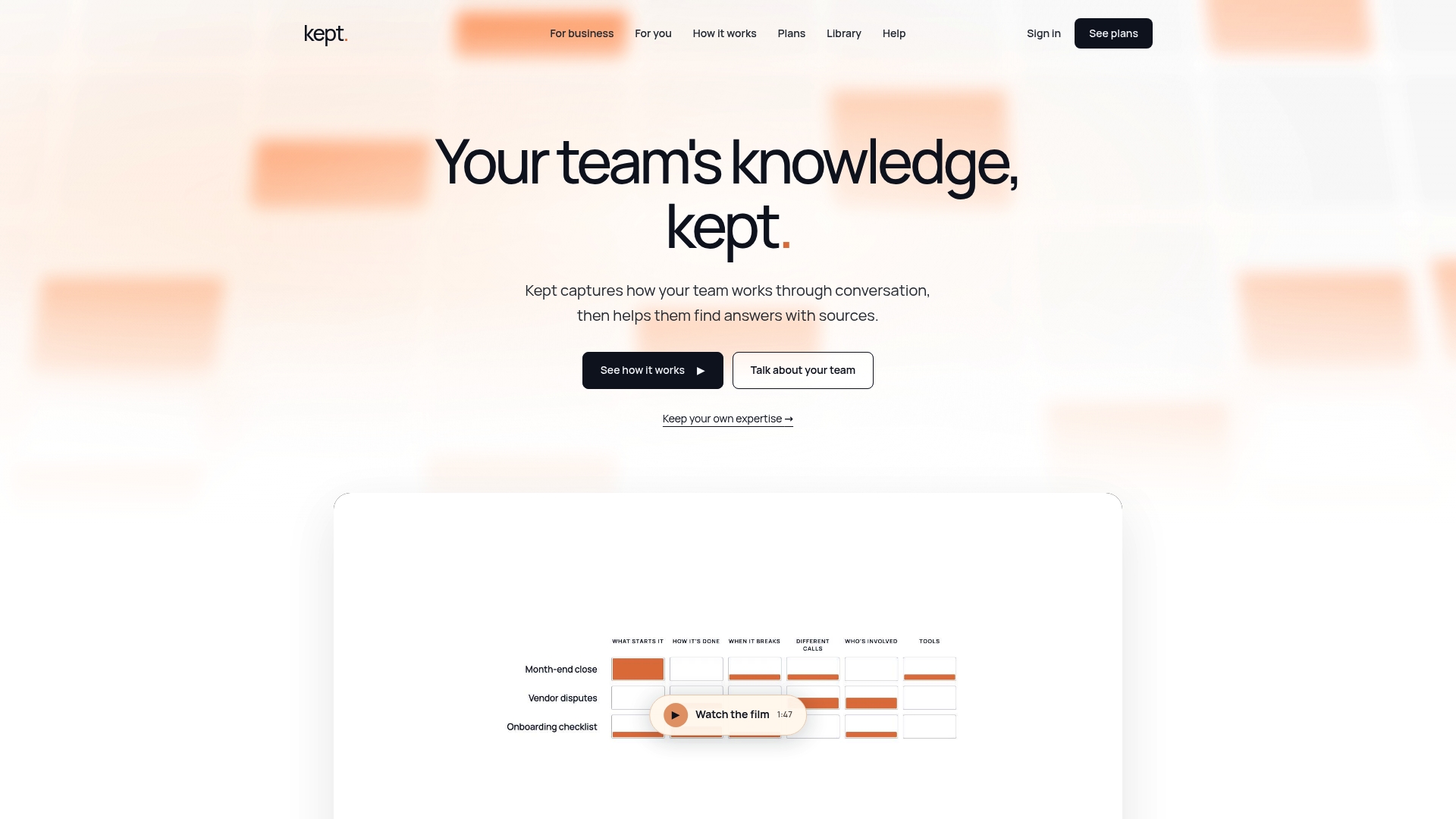
We help teams keep control over what gets shared and what stays private. We recommend starting exactly the way this guide describes: pick a few high-exposure processes, run a focused pilot, and validate the results over a focused period before expanding further.
- Capture judgment and exceptions, not just steps, through guided conversation.
- Keep provenance and ownership visible on every piece of captured knowledge.
- Control access at the workspace level for personal or team use.
| Plan | Built for | Price |
|---|---|---|
| Kept for You | Individual professionals capturing personal expertise | Current prices are on our pricing page. |
| Kept for Business | Teams and organizations capturing shared workflows | Current prices are on our pricing page. |
See how this works for expert handoffs and onboarding, or check current plans and pricing to evaluate fit for your team.
FAQ
How do you capture tribal knowledge?
Start by mapping where critical unwritten expertise lives, then run incident-based interviews, such as the Critical Decision Method, that probe a specific difficult case rather than asking for a general process description. Validate the captured reasoning with a second practitioner and store it as a reference case with a named owner and review date.
Can you still say tribal knowledge?
Yes, "tribal knowledge" remains the standard industry term for unwritten, informally held expertise within a team or organization. It refers to shared know-how passed along through experience and conversation rather than any reference to actual tribes or cultures.
What does it mean when someone says tribal knowledge?
It means knowledge that exists only in people's heads and gets passed along informally, through mentorship, conversation, or trial and error, rather than written documentation. This typically includes judgment calls, shortcuts, and decision rules that experienced employees rely on but rarely write down.
How do you capture tacit knowledge?
Capturing tacit knowledge requires drawing out the reasoning behind decisions, not just the steps of a process, through structured interviews focused on real incidents. Cognitive task analysis research shows that asking about a specific time something went wrong reveals the cues and judgment that generic process questions miss.
Sources
- Tacit Knowledge Is Your Next Competitive Moat | California Management Review
- The Great Retirement: Knowledge Loss, AI and the Workforce Shift Survey Report