

Onboarding documentation should teach new hires how work actually gets done, not just what the org chart says. That means task focused SOPs, checklists, and decision guides, not a stack of HR compliance forms. Conversational AI paired with retrieval-augmented generation preserves the tacit reasoning behind each step, so hires reach full productivity faster. The move: pilot a small capture effort on five to eight high-impact processes over four to eight weeks, and evaluate a platform like Kept as the engine behind it.
TL;DR:
- Capturing tacit knowledge requires structured SME interviews focusing on scenarios and recording walkthroughs to generate reliable, AI-ready workflows.
- Organizing onboarding content with clear metadata, access controls, and a centralized repository ensures new hires locate relevant information quickly during onboarding.
- Piloting on five to ten high-impact processes over four to eight weeks with guided interviews and validation provides fast, measurable proof of value.
- Assigning ownership and establishing a review cadence for each document prevents content from becoming outdated and maintains trust within the organization.
- Kept streamlines the capture and validation process by turning guided conversations into structured workflows, supporting quick deployment and iterative improvement.
Table of Contents
- What belongs in onboarding documentation?
- How do you capture tacit knowledge before it walks out the door?
- How should onboarding documentation be organized so people find it?
- How do you pilot onboarding documentation in under two months?
- Who owns onboarding documentation once it's live?
- Where does Kept fit into this pilot?
- What I'd tell a manager running their first pilot
- Ready to pilot conversational capture?
- Sources
- FAQ
What belongs in onboarding documentation?
Most onboarding documentation fails for a boring reason: it describes the job in general terms instead of the specific action a new hire needs to take right now. Good documentation reads like a set of instructions a competent stranger could follow without asking a colleague for help.
The strongest process document templates include purpose, owner, scope, steps, exceptions, outputs, and version history. Each of those fields exists because leaving it out is what causes onboarding friction later, according to guidance from Elium on writing SOPs teams actually use. A checklist that lists five vague phases is useless. A checklist that lists one clear action per step, with a named owner and a defined output, is what people actually follow under pressure.
Effective onboarding documentation typically includes:
- Step-by-step SOPs written as one action per line, each tied to an owner and an expected output
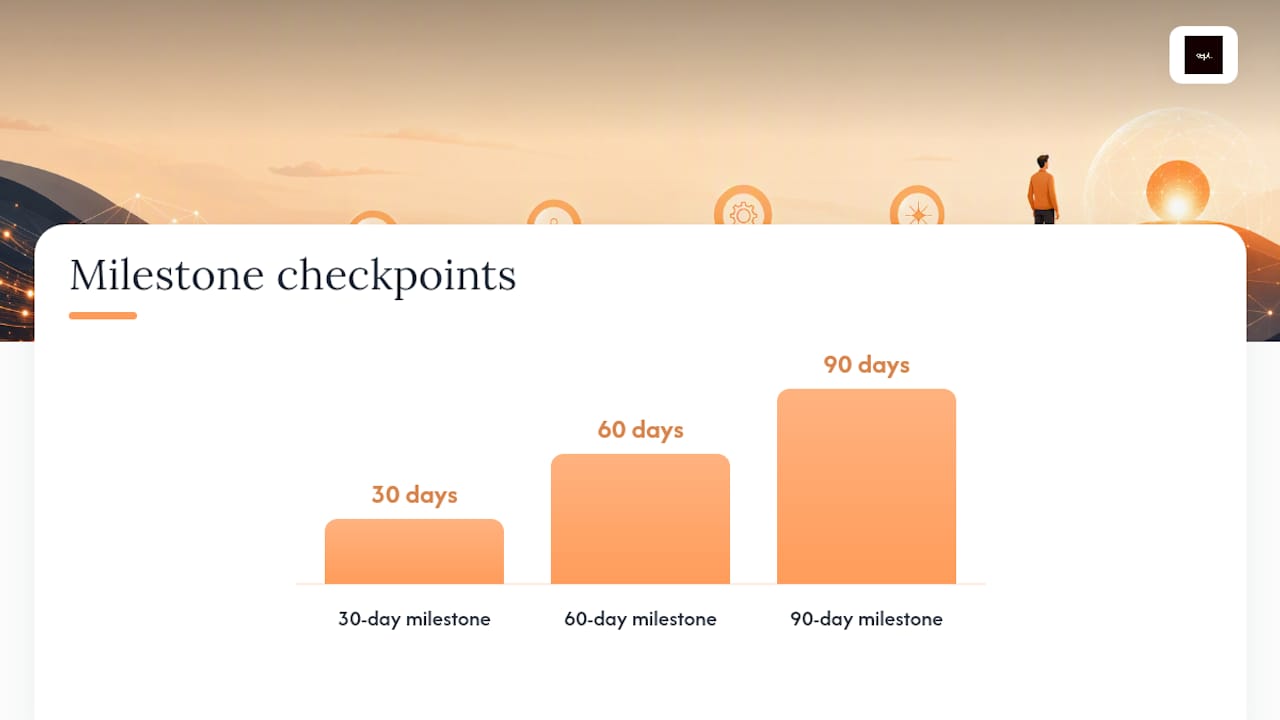
- Role-based 30-60-90 day milestones that state exactly where a hire finds each resource
- Process maps and decision criteria that spell out common exceptions, not just the happy path
- Screenshots or short screen recordings paired with brief notes on why a judgment call gets made a certain way
- A clear split between company-wide basics (culture, org structure) and role-specific workflows, so hires aren't hunting through onboarding training resources meant for another team
How do you capture tacit knowledge before it walks out the door?
The hardest part of any employee onboarding guide isn't writing down the steps. It's extracting the reasoning a veteran employee applies without thinking. That judgment lives in their head, not in any wiki page, and it disappears the day they leave.
Guided SME interviews, thirty to sixty minutes, structured around specific scenarios rather than open-ended questions, surface far more of that reasoning than a written questionnaire ever will. Pair the interview with a short screen recording of the person actually doing the task. Those two inputs, transcript plus recording, become the raw material for a RAG pipeline that generates a draft SOP and a set of contextual questions and answers an AI system can answer later. Research on RAG-enhanced GenAI shows this exact pattern working in practice: capturing implicit knowledge from expert interviews in a purchasing department and turning it into retrievable organizational knowledge that the team could reuse for decisions, not just reference. Guided interviews that push subject matter experts to articulate exceptions and decision criteria consistently surface knowledge that plain documents miss entirely.
Every draft needs SME validation before publication. Governance matters just as much as capture:
- Get explicit consent before recording any interview or screen session
- Review drafts for bias introduced by a single SME's blind spots
- Keep an audit trail showing who validated what and when
Pro Tip: Ask each SME "what would a new hire get wrong here in their first month?" before you ask them to describe the process. You'll get the exceptions first, which is usually the part nobody bothers to write down.
How should onboarding documentation be organized so people find it?
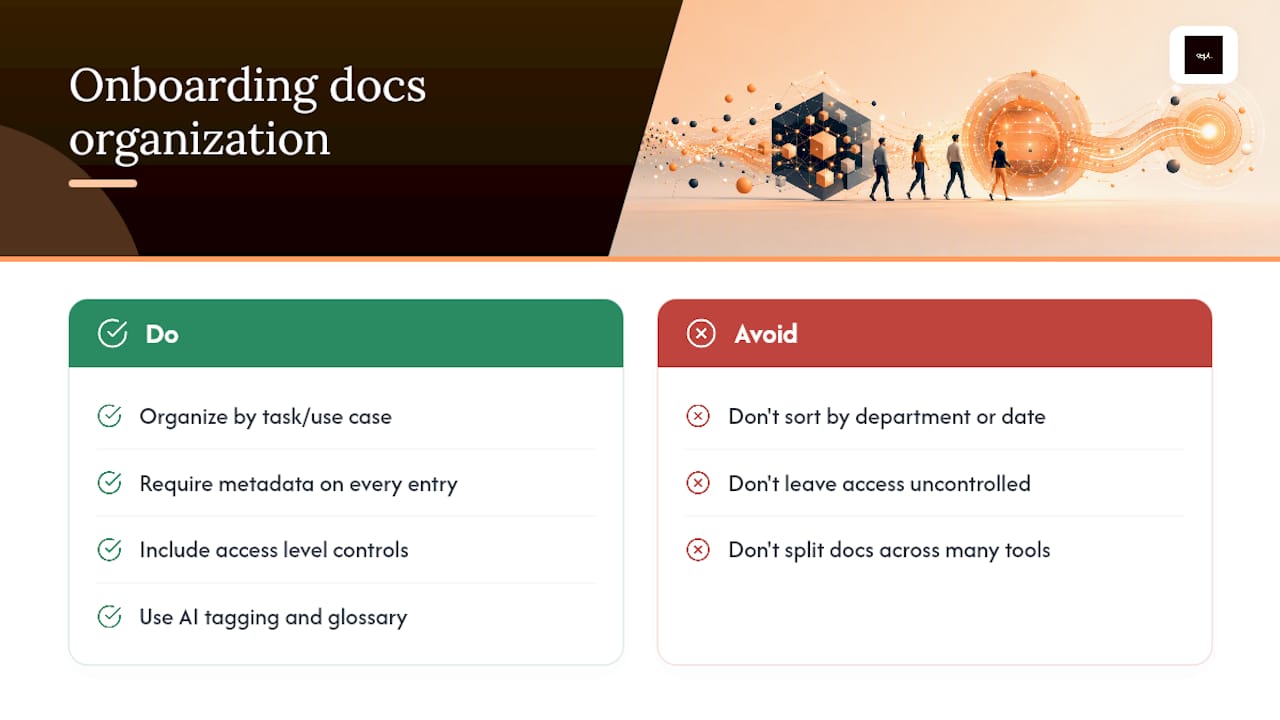
New hires search for what they need to do, not for which department wrote the document. Organizing your onboarding process checklist by task or use case beats organizing it by department or creation date every time, because a hire troubleshooting a client escalation doesn't care whether the answer sits in the sales folder or the support folder.
A workable taxonomy needs consistent metadata on every entry: role, frequency of use, last updated date, owner, a rough complexity score, and required access level. That last field matters more than people expect. Documentation with no access controls tends to get treated as optional reading; documentation gated to the right role signals it's load-bearing.
AI-driven tagging, backed by a shared company dictionary of internal jargon, keeps search results consistent even as different teams write in different styles. And pick one home for published material, whether that's a wiki or a dedicated runbook repository, with version control enforced from day one. Splitting documentation across five tools guarantees someone finds the outdated copy first.
How do you pilot onboarding documentation in under two months?
You don't need a company-wide rollout to prove this works. A tight pilot on a handful of processes shows the value faster than any planning document, and it gives you real evidence before you ask leadership for budget.
- Prioritize five to ten processes using a simple filter: how often it happens, how complex it is, and how much damage a mistake causes. Skip anything low-frequency and low-stakes.
- Capture the knowledge through guided SME interviews and screen recordings, collecting any existing artifacts (spreadsheets, old wiki pages, email threads) as supporting material.
- Generate drafts through a RAG pipeline, then route every draft back to the SME for sign-off before it goes anywhere near a new hire.
- Publish with full metadata, owner assigned, access controls set, and run a short training session so the team knows the documentation exists and where to find it.
- Measure and iterate, tracking time to productivity, 30-60-90 milestone completion, and whether people actually find answers when they search.
Pro Tip: Run the pilot on one team's onboarding first, not five teams at once. You want clean feedback on whether the format works before you scale the taxonomy across the company.
A five-step capture and publish loop like this, identify, capture, structure, publish, review, is what turns a documentation project from a one-time scramble into a repeatable process your team can run again for the next high-impact gap.
Who owns onboarding documentation once it's live?
Documentation without an owner rots. Assign a directly responsible individual to each document, and set a review cadence, quarterly for anything used weekly, less often for rarely touched processes.
Organizations that centralize and structure onboarding knowledge see new hires reach full productivity 70% faster than teams relying on ad hoc, tribal knowledge, according to AIHR's research on onboarding activities. That single number is the strongest argument for building this system before the next hire starts.
Governance checklist for any AI-assisted capture effort:
- Consent and transparency with every SME before recording
- Data retention limits and a documented deletion process
- Periodic bias audits on AI-generated drafts
- A named reviewer for every document, not just an author
Trust and adoption remain the real obstacle for AI-enabled knowledge systems, and change management determines whether people actually use what gets built, not just whether it exists. A framework like Kotter's eight-step model, building urgency, forming a coalition, communicating the vision, works well here because it treats documentation adoption as a behavior change project, not a software rollout.
Where does Kept fit into this pilot?
Kept lets SMEs describe a process in their own words through a guided conversation, then turns that transcript into a structured workflow with the decision logic intact, not stripped out. Workspace-level access controls and context-aware search support the validation and review steps this playbook requires, so a document owner can confirm accuracy before publication rather than after a new hire hits a wall.
What I'd tell a manager running their first pilot
Start with ten documents, not a hundred. Insist on named ownership from day one, because unowned documentation drifts out of date within a quarter. Prioritize pre-boarding material and one fully validated SOP over broad coverage; that single document eliminates most first-week questions.
Resist the urge to document every low-stakes task just because it's easy to record. And favor peer review from the SME's own teammates over a top-down mandate handed down by HR. People trust documentation their peers vouched for.
— Anthony
Ready to pilot conversational capture?
A platform like Kept fits directly into the capture, structure, publish, measure loop this playbook describes. Instead of asking managers to write documentation from scratch, Kept runs the guided conversation, generates the structured draft, and routes it back for SME review, which is the exact workflow the five-step pilot above calls for.
HR teams evaluating this approach can start with Kept's HR and people use cases to see how the guided interview format applies to onboarding specifically, or review Kept for Business for a company-wide view of workspace setup and access controls. If governance and data handling are your main concern before committing to a pilot, Kept's trust center covers consent, retention, and security practices in detail. The next step is straightforward: pick your five highest-impact processes and run a scoped pilot before your next hire starts.
Sources
- AIHR — onboarding activities
- Retaining explicit and implicit knowledge with RAG-enhanced Generative AI
FAQ
What is onboarding documentation?
Onboarding documentation is the set of task-focused SOPs, checklists, and role-based guides that teach a new hire how to perform their job, distinct from HR compliance paperwork like tax forms.
How long should an onboarding documentation pilot take?
A focused pilot covering five to ten high-impact processes typically runs four to eight weeks, from SME interviews through published, validated documentation.
Can AI really capture tacit knowledge, not just written steps?
Guided SME interviews combined with RAG pipelines have shown they can extract implicit decision logic from expert conversations and turn it into retrievable, reusable knowledge, not just a written procedure.
How much faster is onboarding with structured documentation?
Companies with centralized, well-structured onboarding knowledge report new hires reaching full productivity 70% faster than teams relying on informal, tribal knowledge.
Who should own onboarding documentation once it's published?
Every document needs a named directly responsible individual and a set review cadence, quarterly for frequently used processes, to prevent the content from going stale.