
Effective knowledge management runs on seven practices: pilot before you scale, tie every effort to a business outcome, put real governance behind it, build a sharing culture, standardize how knowledge gets captured, embed retrieval into daily tools, and measure activity, experience, and results, not page views. APQC and ISO 30401 both frame knowledge management as a managed system, and Kept's own approach to conversational capture reflects the same logic in practice.
TL;DR:
- Focusing on one bottleneck and thoroughly baselining it ensures the pilot can prove measurable improvements before scaling efforts.
- Tying knowledge management to specific business outcomes, such as reduced onboarding or increased productivity, enhances accountability and supports ongoing investment.
- Embedding governance, ownership, and regular review cycles are critical to maintaining and evolving the program beyond initial implementation.
- Measure in three distinct areas—contribution activity, user search experience, and actual business outcomes—to accurately gauge effectiveness and guide improvements.
- Using conversational capture tools like Kept preserves contextual judgment and integrates seamlessly into workflows, increasing knowledge retention and usability.
Table of Contents
- Knowledge Management Best Practices You Can Start This Quarter
- Building the Governance Backbone: Business Case, Owners, and Review Cycles
- Getting People to Actually Share What They Know
- What to Capture and How to Keep It Findable
- Choosing Tools That Fit the Work, Not the Demo
- How to Measure Knowledge Management Beyond Page Views
- The Pilot-to-Scale Sequence, Step by Step
- How Conversational Capture Preserves Context Documents Miss
- Five Pragmatic Rules for Knowledge Management Leaders
- A Practical Next Step With Kept
- Where This Guidance Comes From
- Sources
- FAQ
Knowledge Management Best Practices You Can Start This Quarter
Most knowledge management programs fail for a boring reason: they try to document everything at once. The ones that work start narrow, prove value fast, and expand only after the numbers back them up. Here are eight practices, in the order that tends to produce results.
1. Pilot one bottleneck before touching anything else. Pick the single process that costs the most in repeated questions, delayed onboarding, or rework, and document just that one. Quick actions: identify the team's most-asked question, baseline how long it currently takes to resolve, and set a 30-day pilot window. The pitfall: trying to migrate an entire wiki or shared drive on day one, which guarantees a stalled project and no clean baseline.
2. Tie the effort to a business outcome, not a content goal. "We documented 200 procedures" is not a result. "New hires reached full productivity two weeks faster" is. Quick actions: name one metric the pilot must move, get a stakeholder to agree on the target number before you start, and revisit that target monthly. The pitfall: measuring output (articles written) instead of impact (time saved, errors avoided).
3. Put a governance structure behind it before it grows. APQC's 2025 benchmarking work recommends designing programs around a business case, staffing, governance, and measurement together, not treating a repository as the whole strategy. Quick actions: name one accountable sponsor, define who owns content quality, and schedule a quarterly review. The pitfall: launching a tool without anyone responsible for what happens to it six months later.
4. Secure a sponsor who will defend the budget. APQC's guidance on high-impact programs is blunt about this: executive sponsorship and embedded operational owners have to work together, or participation stalls once the initial excitement fades. Quick actions: get a named executive to co-sign the pilot's goals, ask them to mention it in one all-hands meeting, and give them a one-page summary of early wins to share upward. The pitfall: sponsorship that is a signature on a memo and nothing more.
5. Build a culture where sharing beats hoarding. Recognition programs, leadership modeling, and linking documentation to performance conversations all move the needle more than mandates do. Quick actions: have a manager document one process publicly first, credit contributors by name in team updates, and ask new hires what they wished someone had written down. The pitfall: rewarding volume of contributions instead of usefulness.
6. Standardize what gets captured and how. Inconsistent formats are why old wikis become graveyards. Quick actions: build one template with fields for decision, exceptions, and last-reviewed date, agree on five taxonomy terms before adding fifty, and assign a reviewer for each category. The pitfall: letting every team invent its own structure, which kills searchability within a year.
7. Put knowledge where the work already happens. A brilliant document nobody opens is worthless. Quick actions: embed search results into the tools your team already uses, add a "how do I" link inside your ticketing or CRM system, and test retrieval with someone outside the authoring team. The pitfall: building a separate portal that requires a extra login and extra habit.
8. Measure, then iterate, on a real cadence. ISO 30401 treats knowledge management as a system that gets reviewed and improved continually, not launched once and left alone. Quick actions: set a 90-day review, track one activity metric and one outcome metric side by side, and kill anything that shows no reuse after two quarters. The pitfall: never revisiting the pilot's original targets.
Pro Tip: Run your first pilot on the process your best people get asked about the most. If three colleagues interrupt the same senior engineer every month with the same question, that is your bottleneck, and it is already costing you measurable time.

Building the Governance Backbone: Business Case, Owners, and Review Cycles
A knowledge management strategy without governance is a wiki with good intentions. ISO 30401 frames knowledge management as a management system, meaning it has to be established, implemented, reviewed, and continually improved, the same discipline you'd apply to quality or safety programs. That framing matters because it forces a question most teams skip: who owns this after the launch enthusiasm wears off?
Start by mapping knowledge management goals directly to strategic priorities you already report on. If leadership cares about time-to-productivity for new engineers, your pilot's success metric should be time-to-productivity, not "number of articles published." APQC's benchmarking research recommends building the business case, governance model, staffing plan, and measurement approach as one connected package rather than bolting measurement on at the end.
Two governance models cover most organizations:
- A central KM core team works when the organization is small enough that one group can reasonably own taxonomy, tooling, and quality across departments.
- Embedded owners inside each function work better past a few hundred employees, with a lightweight core team setting standards and auditing compliance.
Before you scale past the pilot, confirm you have:
- A written scope statement (what's in, what's explicitly out)
- Two or three KPIs tied to business outcomes, not content volume
- A funding line that survives past the first fiscal year
- A quarterly or semiannual audit cadence written into someone's calendar
Pro Tip: Write the review cadence into the sponsor's calendar invite, not a project plan nobody reopens. Governance that lives only in a document dies with the document.
Getting People to Actually Share What They Know
Most knowledge-sharing programs collapse because they reward the wrong behavior. Counting contributions encourages people to submit low-value scraps just to hit a quota, and quality suffers exactly when you need it most. APQC's research on program metrics recommends measuring whether content gets reused and produces operational impact, not counting submissions alone.
Leadership modeling still beats almost every other lever. When a senior manager documents their own decision process publicly, first, it signals that sharing knowledge is not an admission of replaceability, it's expected behavior at every level. Recognition works better when it's specific: crediting a named contributor in a team update lands harder than a generic leaderboard.
A realistic 90-day plan looks like this: weeks 1 through 2, identify the five most-repeated questions on your team and their current "expert." Weeks 3 through 6, run guided documentation sessions with those experts and publish the results with named credit. Weeks 7 through 10, track how often that content gets reused versus how often the original expert gets re-interrupted with the same question. Weeks 11 through 13, report the reduction in interruptions to your sponsor as the pilot's core result.
- Track reuse rate, not submission count, as your headline culture metric.
- Link documentation contributions to development conversations, not just recognition emails.
- Ask departing employees what they know that nobody else does, before their last week, not during it.
- Measure whether the same question keeps recurring after documentation goes live.
What to Capture and How to Keep It Findable
Most documentation efforts fail on specifics, not intent. Teams know they should "write things down," but nobody defines what belongs in a knowledge base versus what belongs in a training deck versus what should stay in someone's head as tacit judgment. That ambiguity is where knowledge bases go to die.
Capture decisions, exceptions, and the reasoning behind them, not just the standard procedure. A clean SOP tells you what to do when everything goes right. It says nothing about what to do when a client requests something outside policy or when a system throws an error the manual never anticipated. Research on capturing contextual knowledge finds that interviewing subject-matter experts about specific real cases surfaces far more usable judgment than asking someone to write a generic procedure from memory. The exceptions are usually the valuable part.
A workable template needs five fields at minimum: the audience it's written for, the decision or action it documents, the inputs required, any known exceptions, and a "last reviewed" date. Skip the last field and you'll have a knowledge base full of confidently wrong information within eighteen months.
- Capture: decisions, exceptions, trade-offs, and the "why" behind non-obvious calls.
- Avoid: restating information already available in a stable, linked system of record.
- Assign metadata tags for audience, process owner, and review date on every entry.
- Set a lightweight approval step before a new taxonomy term gets added, so the term list doesn't fragment into fifty synonyms for the same concept.
Pro Tip: If two people on your team already use different names for the same process, that's your first taxonomy fix. Don't wait for a formal audit to catch it.
Choosing Tools That Fit the Work, Not the Demo
Tool selection derails more knowledge management strategies than any other single decision, because teams buy for the demo instead of the daily workflow. A tool that looks impressive in a sales call but sits outside where people actually work will get ignored within a month.
Run the fit test before you run the vendor comparison:
- Does it match your actual use case (quick lookup, deep procedural documentation, exception handling) or just look flexible?
- Does it integrate with the systems your team already opens ten times a day?
- Is search quality good enough that someone finds an answer in under a minute?
- Does metadata get captured automatically, or does it depend on someone filling out a form correctly every time?
- What access controls exist at the workspace or team level, and who can see what?
AI-powered capture and retrieval tools raise a separate set of questions. APQC treats AI as an enabler within the broader people-process-technology model, not a replacement for governance. This means the evaluation bar has to go past "it sounds fluent." Check provenance (where did this answer come from), freshness (when was it last updated), permission boundaries (does it respect who's allowed to see what), and whether citations are auditable back to a source. A tool that answers confidently but can't show its source is a liability in any regulated or client-facing process.
A tool with conversational capture can help track which processes are captured and which experts still hold undocumented knowledge, but the deeper principle applies regardless of vendor: integrate retrieval into the workflow itself, through connectors and embedded search, rather than forcing people to leave their task to go look something up. Big-bang migrations from an old system to a new one tend to fail for the same reason pilots succeed: scope. Move one team's most-used content first, prove it works, then expand.
Roughly a third of knowledge management budgets in mature programs go toward integration and maintenance rather than the initial tool purchase, according to APQC's benchmarking research, a reminder that the software itself is rarely the expensive part.
How to Measure Knowledge Management Beyond Page Views
Page views tell you almost nothing useful. Someone can open an article, fail to find the answer, and leave, and your analytics will record that as a "view" indistinguishable from genuine success. APQC recommends measuring at three distinct levels: activity, experience, and business outcomes, and treating them as separate signals rather than collapsing them into one vanity number.
Activity metrics track contribution and reuse: how many articles get created, how often they get referenced again, and by whom. Experience metrics track whether the system actually works for the person using it: search success rate, time to find an answer, and how often someone gives up and asks a colleague instead. Business outcome metrics connect back to the numbers your leadership already cares about: onboarding time, ticket resolution time, and rework or error rates tied to missing documentation.
| Metric Level | Example Metrics | Primary Data Source |
|---|---|---|
| Activity | Contributions created, reuse rate, content freshness | Knowledge base analytics |
| Experience | Search success rate, time to find answer, escalation rate | Search logs, user feedback |
| Business Outcome | Onboarding time, resolution time, rework reduction | HR systems, ticketing systems, manager reports |
Build a simple dashboard around these three rows before you build anything more elaborate. Pull activity data from your knowledge base's own analytics, pull experience data from search logs and quick feedback prompts, and pull outcome data from the systems that already track onboarding and ticket resolution. The dashboard's real job is connecting reuse to outcomes: if content gets reused heavily but resolution times aren't improving, something in the content itself needs fixing, not the platform underneath it.
- Report all three levels together, never activity metrics alone.
- Set a baseline before the pilot starts so improvement has something to compare against.
- Flag content with zero reuse after 90 days for revision or retirement.
The Pilot-to-Scale Sequence, Step by Step
Scaling too early is the single most common cause of stalled knowledge management strategies. The sequence that actually works is short: identify the bottleneck, baseline it, pilot a narrow fix, measure honestly, then decide whether to expand.
- Identify the costliest bottleneck. Look for the process generating the most repeated questions, longest onboarding delays, or highest rework rate. APQC's guidance on program development recommends starting with a narrow bottleneck specifically because it exposes taxonomy and ownership problems while the stakes are still low.
- Baseline before you build anything. Record current time-to-resolve, current onboarding duration, or current error rate. Without this number, you can't prove the pilot worked.
- Design the capture flow for that one process. Decide who gets interviewed, what template captures their knowledge, and who reviews it before publishing.
- Run a bounded pilot, 30 to 90 days. Resist the urge to expand scope mid-pilot; a moving target makes measurement meaningless.
- Measure against the baseline and decide. If the metric moved meaningfully, you have a case for expansion. If it didn't, diagnose why before scaling the same approach to more teams.
Common pitfalls at this stage: no single owner accountable for the pilot's outcome, a taxonomy that grows organically instead of by design, and skipping measurement because "everyone can tell it's helping." Before scaling, confirm you have a named owner for the next phase, a taxonomy that's held for the full pilot without renaming chaos, and a metric that moved in a direction leadership recognizes as meaningful.
How Conversational Capture Preserves Context Documents Miss
Most documentation tools ask someone to write a procedure from memory, which is exactly when the valuable parts get lost. The exceptions, the judgment calls, the reasons behind a workaround, none of that survives a blank text box very well. Kept takes a different route: guided conversational capture, where an employee talks through their actual process, in their own words, and the platform structures that conversation into an organized workflow document.

This approach lines up with what research on capturing contextual knowledge has found for years: interviewing an expert about specific real cases surfaces more usable judgment than asking them to author a generic procedure cold. A guided interview can probe the exception a static template would never think to ask about.
The business outcomes worth tracking after adoption are the same ones this article has stressed throughout:
- Reduction in new-hire time-to-productivity after guided sessions replace ad hoc shadowing.
- Fewer repeated interruptions to senior staff for questions already answered elsewhere.
- Lower knowledge loss when an employee with unique context leaves the organization.
Kept's Trust Center and security documentation cover the access-control and consent details that any team evaluating a capture tool should check before rolling it out company-wide.
Five Pragmatic Rules for Knowledge Management Leaders
Five rules cut through most of the noise in knowledge management planning, based on where these programs consistently succeed or stall.
Measure early, even roughly. A weak baseline beats no baseline; you cannot prove impact against a number you never recorded.
Prioritize reuse over volume. A hundred documents nobody opens again are worth less than ten that get referenced weekly.
Embed ownership before day one. Assign the accountable person before launch, not after the first quality complaint arrives.
Favor simple tools people will actually open. The best knowledge management framework is the one that fits into an existing workflow, not the one with the longest feature list.
Budget for maintenance, not just launch. ISO's own framing treats knowledge management as continual, which means the second year's budget matters as much as the first.
If there's one thing conventional advice underplays, it's that knowledge management dies from neglect far more often than from bad tools. The platforms rarely fail outright. The ownership does.
— Anthony
A Practical Next Step With Kept
Kept works as the conversational alternative to static wikis and shared drives for teams tired of losing context every time someone leaves. Instead of asking people to write procedures from a blank page, Kept guides them through a conversation about how they actually work, exceptions and reasoning included, then structures that into a usable workflow document your team can search and cite.
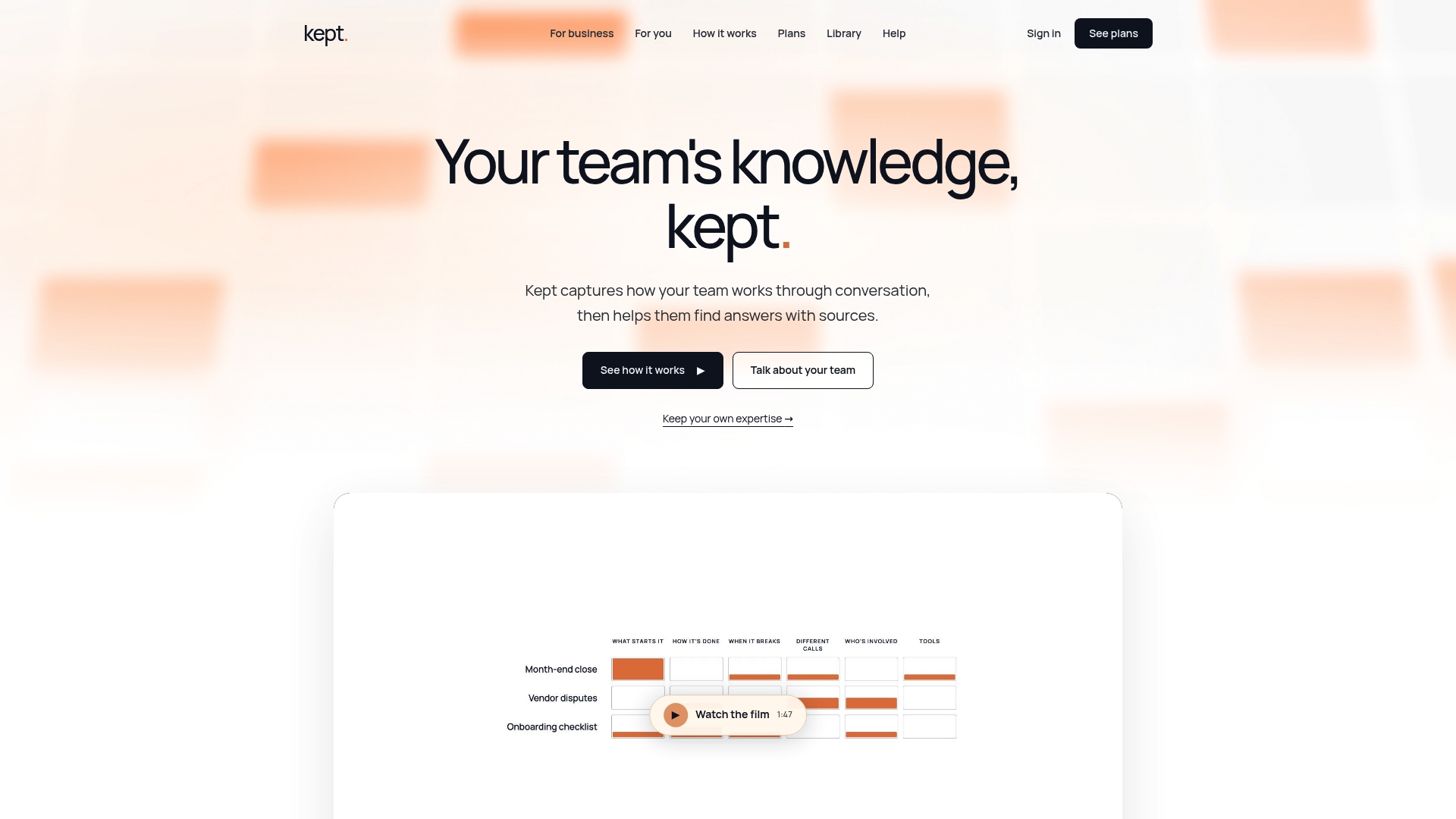
That approach maps directly onto the practices this article covers: it preserves the contextual judgment a generic template misses, it gives teams workspace-level access control instead of an open free-for-all, and it comes with opt-in capture and deletion so contributors keep control over what gets kept and what doesn't. Whether you're documenting one engineer's process before they leave or building out a company-wide knowledge base, the individual Kept for You plan and the team-focused Kept for Business plan cover both scales. Current pricing for both plans is available on the pricing page, and if you want to see the guided capture process before committing, the upcoming live session walks through it in real time.
Where This Guidance Comes From
This article draws on APQC's 2025 KM benchmarking research for practical roadmaps, ISO 30401 for management-system governance, and a systematic literature review on success factors.
Sources
- 2025 KM Program Benchmarks and Metrics | APQC
- ISO 30401:2018 - Knowledge management systems — Requirements
- Systematic literature review identifying KMS critical success factors and emerging trends
FAQ
What are the 5 C's of knowledge management?
Definitions vary across sources, but a common version describes knowledge that is clear, current, findable, contextual, and controlled. Treat it as a memory aid rather than a formal standard. ISO 30401 offers the more defensible framework if you need something audit-ready.
What are the 5 P's of knowledge management?
One common version covers purpose, people, process, platform, and performance, a rough shorthand for the elements a program needs to function. Like the 5 C's, it's a teaching tool rather than a certified framework, so build your actual governance around a management-system standard instead.
What are the four C's of knowledge management?
There's no single agreed-upon "four C's" model in the way ISO 30401 defines governance requirements; sources that use this phrase typically trim a longer C-based list down to four terms. Treat any four-item version as a simplified teaching aid, not an authoritative benchmark.
How do you measure knowledge management effectively?
Measure at three levels: activity (contributions and reuse), experience (search success and time to find an answer), and business outcomes (onboarding time, resolution time, rework reduction), following the model APQC recommends. Page views alone tell you almost nothing about whether the knowledge actually helped anyone.
What is the best way to start implementing knowledge management?
Start with a single, costly bottleneck rather than an enterprise-wide rollout, baseline the current time or cost it takes, and run a bounded pilot before expanding. APQC's program development guidance backs this narrow-first approach because it surfaces taxonomy and ownership problems while they're still cheap to fix.
How much does Kept cost?
Kept offers a personal plan, Kept for You, and a team plan, Kept for Business, both without published flat rates. Current pricing details for either plan are available on Kept's pricing page.