
The fastest way to document what a subject matter expert knows is a short, guided semi-structured interview: walk them through the process step by step, then ask "why" at every decision point. Record it with consent, and you should walk away with four things: a recording, a transcript, a draft process model, and a running list of exceptions the SME flagged along the way.
TL;DR:
- Using scenario prompts that combine normal cases with exceptions helps reveal hidden judgment calls and uncommon steps often overlooked in standard interviews.
- An interviewer with domain knowledge can better identify when SMEs rely on instinct or shortcuts, ensuring all critical decision points are documented accurately.
- A semi-structured interview format validated most steps from initial open discussions but also uncovered hidden or omitted actions through follow-up questioning.
- Documenting only the happy path leads to missing essential exceptions, so presenting edge cases during interviews increases the likelihood of capturing true process variability.
- Employing tools that turn guided conversations into structured process models with attached exceptions prevents incomplete documentation and accelerates validation.
Table of Contents
- Pre-interview checklist: scope, consent, artifacts, and interviewer role
- Categorized SME interview questions with examples you can copy
- Which elicitation method to use and how to sequence them
- How to convert interview output into a draft model and validate it with the SME
- Common mistakes to avoid and high-impact interviewer tips
- Why domain familiarity changes what an interview captures
- Kept turns guided interviews into documentation without the manual write-up
- Sources
- FAQ
Pre-interview checklist: scope, consent, artifacts, and interviewer role
Before you schedule anything, decide exactly what you are documenting. "How we handle vendor onboarding" is too broad. "The credit check and approval steps for new vendors over $10,000" gives the SME something concrete to walk through, and gives you a way to know when the interview is done.
Consent is not a formality. Tell the SME what you are recording, why, who will see the transcript, and how long it will live in your systems, before you hit record. Kept's own voice capture and consent practices are a useful reference point for what that conversation should cover.
Bring artifacts. A blank page produces vague answers. Screenshots, sample forms, error logs, or last month's ticket queue give the SME something to react to, which surfaces detail they would otherwise skip as "obvious."
- Define the specific process, decision, or output you want documented, not a general topic area.
- Set a timebox (a timebox of about an hour to an hour and a half works for most single processes) and share the agenda in advance.
- Get explicit recording consent and explain how the transcript will be stored and used.
- Gather screenshots, logs, or forms the SME can point to during the walkthrough.
- Assign an interviewer with enough domain familiarity to catch when an answer is incomplete.
That last point matters more than it looks. An interviewer who knows the domain can act as a knowledge referee, someone who notices when an SME's shorthand is hiding a judgment call rather than describing a fixed rule.
Categorized SME interview questions with examples you can copy
Good elicitation questions do one of five jobs: they open the conversation, they map the normal flow, they probe a decision, they hunt for exceptions, or they confirm what you heard. Mixing all five into one freeform chat is how interviews drift. Working through them in order is how you get a usable draft.
- Opening and rapport. "Walk me through what happens from the moment this task lands on your desk." This lowers the activation energy that keeps SMEs from opening up, and it gets the domain vocabulary on the table early.
- Step-by-step walkthrough. "What's the very next thing you do after that, and how do you know it's ready to move forward?" Repeat this until the SME reaches the end state.
- Decision and trade-off probes. "Why did you choose that option over the alternative?" and "What information would have to change for you to decide differently?"
- Exception and red-flag questions. "What's the weirdest version of this you've seen?" and "What would make you stop and escalate instead of continuing?"
- Verification and prioritization. "Of everything we just covered, what's the one step that, if skipped, causes the most damage?"
Pro Tip: Ask "what would make you stop" before you ask "what do you usually do." SMEs describe the happy path by default, and reversing the order forces the exception into view first.
Keep the categories in sequence but let answers dictate pacing. A single "why" question at a decision point often produces more usable documentation than five step-tracing questions in a row, because it surfaces the judgment the SOP never wrote down.
Which elicitation method to use and how to sequence them
The order matters as much as the questions themselves. Start unstructured: let the SME describe the process in their own words with minimal interruption. This surfaces vocabulary and the rough shape of the process before you impose any structure on it.
Once you have that first pass, build semi-structured questions from it, one for each step, decision, and handoff you heard. This second round is where you confirm coverage and catch gaps the open conversation missed. A UMass study on process elicitation found that semi-structured interviews validated most of the normal steps captured in the initial unstructured pass, but also disputed or added steps the first round missed entirely.
The final layer is scenario prompts: present a partial situation, mostly a normal case with a couple of unusual twists, and ask the SME to react. Research found that scenario-based prompts surface exceptional steps more reliably than simply reviewing a written process description.
- Open with unstructured questions to capture vocabulary and rough shape.
- Follow with semi-structured questions built directly from what you just heard.
- Close with scenario prompts that mix one normal condition with several edge cases.
- Take notes on paper or a second screen so the recording stays uninterrupted.
How to convert interview output into a draft model and validate it with the SME
Turn the recording into a transcript and a simple process map or checklist within a day or two, while the conversation is still fresh in your interviewer's memory. A flowchart with decision diamonds at the trade-off points is usually enough; formal process notation is not needed for a first draft.
Then bring that draft back to the SME. This validation session is not a formality either, it is where disputed steps get resolved and omissions surface. The same UMass research that supports semi-structured interviews also found that later interviews confirmed most, but not all, of what the first pass produced, which is exactly why a second look matters.
A validation session that mixes scenario checks with direct step review catches disputed or omitted steps that a single unstructured pass alone will miss, according to the same UMass case study.
- Attach metadata to each step: how often it occurs, what triggers an exception, and what failure looks like.
- Walk the SME through the draft model section by section rather than asking for a blanket approval.
- Flag any step the SME hesitates on and resolve it in the same session if possible.
- Schedule a short follow-up call for anything still unresolved rather than guessing.
Common mistakes to avoid and high-impact interviewer tips
The most common failure is documenting only the happy path. An SME describes the standard sequence fluently because they have done it a thousand times, and the interviewer stops there because it sounds complete. It rarely is. Every process has exceptions the SME handles by instinct and never mentions unless asked directly.

The second failure is assuming a choice was obvious. When an SME says "I just knew to escalate it," that is not an answer, it is a signal to ask "what specifically told you that?" Treating fluency as completeness is how documentation ends up missing the judgment calls that actually matter.
Pro Tip: Build one or two partial scenarios in advance that combine a normal condition with a likely exception, and use them near the end of the interview. The UMass elicitation study found this format surfaces exceptional steps more reliably than a general recap question.
Why domain familiarity changes what an interview captures
I've come to think the interviewer matters more than the question list. Someone unfamiliar with the domain can run through every question on this page and still miss the moment an SME's shorthand is covering a judgment call rather than a fixed rule. A domain-familiar interviewer catches that instantly and asks the follow-up that unlocks it.
You don't need to hire specialists for this; tools like Resyme offer a shortcut to the right person, combining technology and people effectively. Pairing a generalist interviewer with someone who has enough domain grounding to act as a knowledge referee, or giving that generalist a short training pass beforehand, closes most of the gap. Build that capability once and every future interview gets sharper.
— Anthony
Kept turns guided interviews into documentation without the manual write-up
Everything above works with a notebook and a recorder, but the write-up afterward is where most documentation efforts stall. Some platforms run the guided interview itself: they ask the step-by-step and "why" questions in the SME's own words, capture the recording with consent built into the flow, and turn the conversation directly into a structured process model with exceptions attached, not a transcript someone still has to summarize.
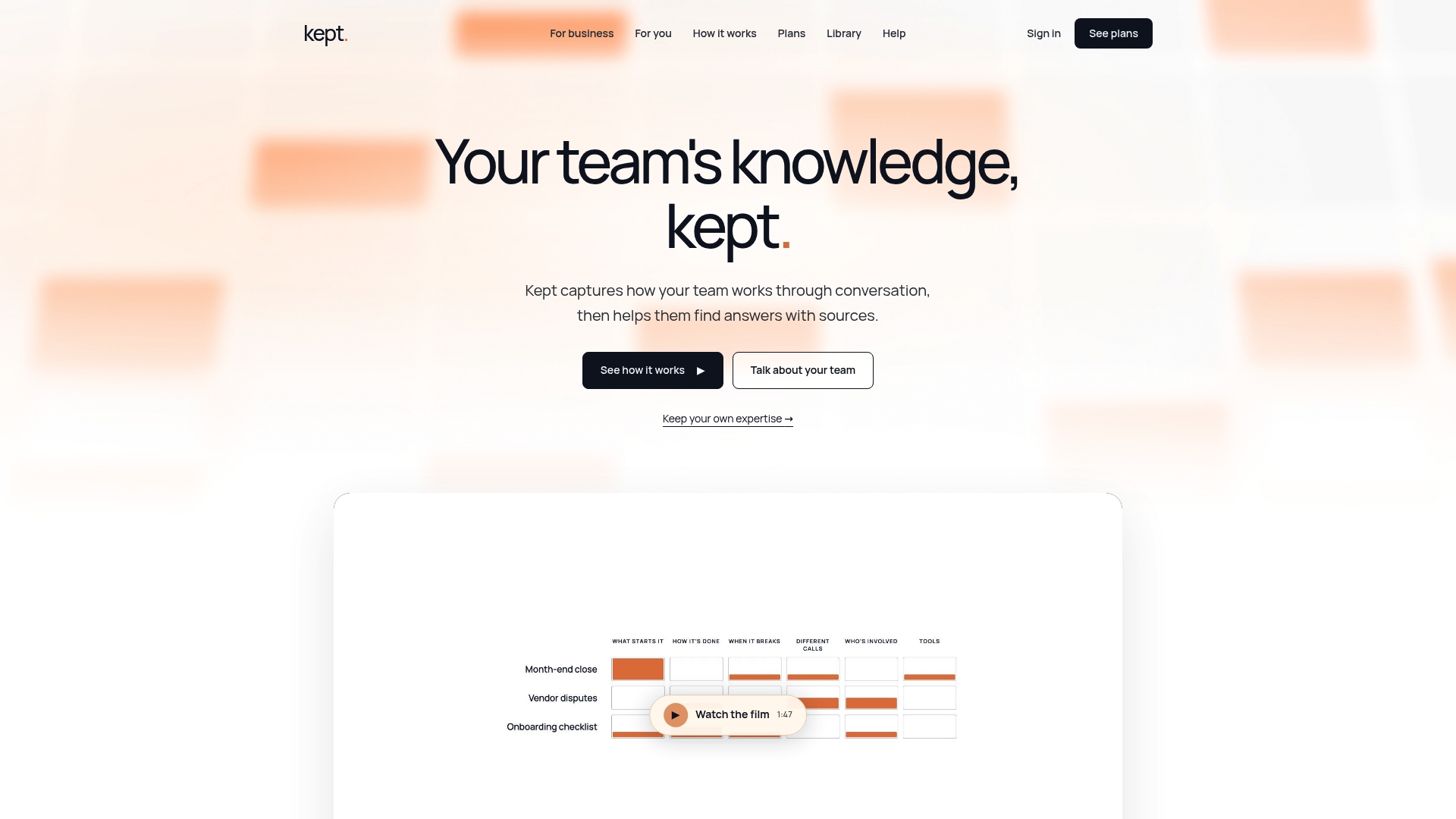
That matters most for the process most teams skip documenting the reasoning behind decisions, not just the steps. Kept for Business is built for exactly that gap between what a procedure says and what the person doing it actually knows. See how it fits your team on the Kept for Business page, or check pricing for individual and team plans to get started.
Sources
For readers who want the underlying research:
- Assessing the Effectiveness of Five Process Elicitation Methods: A Case Study of Chemotherapy Treatment Plan Review
- Using a Lessons Learned Process to Develop and Maintain Institutional Memory and Intelligence
FAQ
What is a semi-structured interview for SME knowledge capture?
It's an interview built from an initial open conversation with the expert, then organized into specific questions covering each step, decision, and exception mentioned. Research on process elicitation methods found this format confirms most normal steps while also surfacing disputed or missing ones.
How long should an SME interview take?
Most single-process interviews fit into a timebox of about an hour to an hour and a half, which is the enough time to walk through the steps, probe a few decisions, and run one or two exception scenarios. Longer sessions tend to lose the SME's focus before you reach the edge cases that matter most.
Should I record SME interviews?
Yes, with explicit consent given before recording starts, since a transcript preserves the SME's exact reasoning better than notes taken live. Tools built for this, including Kept's voice capture and consent flow, make the consent step part of the process rather than an afterthought.
What's the best way to surface exceptions an SME might not mention?
Present a partial scenario that mixes a normal situation with one or two unusual twists and ask how they'd handle it. The UMass study found this approach surfaces exceptional steps more reliably than asking the SME to review a written process description.
Who should conduct SME knowledge capture interviews?
Someone with enough domain familiarity to recognize when an SME's shorthand is hiding a judgment call, sometimes called a knowledge referee. NASA's lessons-learned research found interviewer domain experience critical to avoiding misinterpretation during capture.