
The best first step is simple: start with AI-assisted probes grounded in artifacts your experts already produce, tickets, chat logs, decision notes, before you ever ask anyone to write a manual. Governance and prioritization come next, but they follow the capture, not the other way around.
TL;DR:
- Focusing on passive AI-assisted capture of artifacts and decision logs ensures more accurate and less intrusive knowledge collection than asking experts to manually document processes.
- Reflective video-stimulated interviewing and artifact-grounded conversations surface tacit reasoning more effectively by prompting experts to explain their decisions in real context.
- Prioritizing knowledge capture based on concentration risk, business impact, replaceability, and attrition risk helps avoid overextending efforts and targets high-value areas first.
- Running short, six-week pilots with clear metrics such as onboarding time and escalation rates provides measurable validation before scaling knowledge management initiatives.
- Continuous, embedded capture and validation by humans outperform one-time interviews, preventing knowledge decay and ensuring captured insights remain relevant over time.
Table of Contents
- Practical elicitation techniques that surface tacit knowledge
- AI-driven capture: conversational agents, RAG, and knowledge graphs
- Map, prioritize, and scope: where tacit knowledge lives
- Challenges, governance, and trust in tacit knowledge management
- Six-step pilot plan and checklist to validate capture in 4 to 8 weeks
- Kept's approach to conversational capture
- Strategies for converting tacit knowledge into explicit knowledge
- Methods for validating and testing captured tacit knowledge
- Techniques for encouraging knowledge sharing and overcoming cultural barriers
- Tools and technologies supporting tacit knowledge management beyond capture
- Case studies showing successful and unsuccessful tacit knowledge capture initiatives
- What KM teams keep getting wrong about tacit knowledge
- A practical route to capture with Kept
- Sources
- FAQ
Practical elicitation techniques that surface tacit knowledge
Some knowledge only comes out when you ask the right question at the right moment, which is why classic elicitation methods still matter even as AI tools enter the picture. Structured interviews and cognitive task analysis work well for decisions with clear steps and identifiable decision points, like a troubleshooting sequence or an approval workflow with judgment calls baked in. They are slower to run but produce clean, comparable data across multiple experts.
Direct observation, shadowing, and informal apprenticeship catch the knowledge that experts themselves have stopped noticing, the small adjustments, the skipped steps, the instinctive checks. These methods are intrusive and time-consuming, but for roles where the gap between what people say they do and what they actually do is wide, there is no substitute.
Reflective video-stimulated interviewing (VSI) deserves particular attention. Rather than asking an expert to recall a decision from memory, VSI shows them a recording of their own recent work and asks them to narrate what they were thinking. Research on reflective VSI found that this reflective approach surfaces tacit reasoning more effectively than recall-based interviewing, because the stimulus is close to the expert's normal practice and prompts genuine sense-making instead of a reconstructed story.
Before running any of these, collect the artifacts that will anchor the conversation:
- Decision logs and escalation notes from the past few months
- Annotated examples of finished work, especially edge cases
- Support tickets or chat threads tied to nonstandard situations
Pro Tip: Pull three or four real tickets before an interview and ask the expert to walk through their thinking on each one instead of asking abstract questions.
The tradeoff across all of these is time and access. Observation demands proximity and trust, interviews demand scheduling and skilled facilitation, and VSI demands recordings that may raise privacy questions worth settling upfront.
AI-driven capture: conversational agents, RAG, and knowledge graphs
Retrieval-augmented generation, or RAG, lets a conversational agent ground its questions and summaries in an organization's own documents rather than generic training data. Instead of guessing at how your team handles an exception, the agent pulls from actual tickets, wikis, and decision logs, then asks the expert to confirm, correct, or elaborate. This keeps the conversation specific and reduces the chance of the agent inventing a plausible-sounding but wrong procedure.
Socially interactive agents, or SIAs, take this further by combining large language models with RAG and dialog strategies designed to build rapport, not just extract answers. A bibliometric review of AI and knowledge processes describes a field-wide shift from manual, document-based codification toward AI systems positioned as an epistemic partner in interpreting expert judgment rather than a passive recorder of it.
AI capture works best passively first, actively second: ingest what experts already produce, then use conversational probes to fill gaps, rather than asking them to author documentation from scratch, according to California Management Review.
A few practices matter here:
- Build a semantic layer or knowledge graph that encodes relationships between decisions, exceptions, and the conditions that trigger them.
- Use chain-of-thought style prompts that ask "what made you choose this over the alternative" rather than "what did you do."
- Keep a human reviewer in the loop to catch confident-sounding errors before they enter the knowledge base.
None of this replaces judgment. An agent can surface a pattern across a hundred tickets, but only a person can say whether that pattern is a rule worth keeping or a habit worth breaking.
Map, prioritize, and scope: where tacit knowledge lives
Before capturing anything, find out who actually holds the knowledge and how it moves, informally, between people. That usually means asking managers who gets pulled into escalations, tracking which names appear repeatedly on the hardest tickets, and noting which processes run smoothly only when one specific person is in the room.
Once you have a rough map, prioritize with four criteria:
- Concentration risk: how many people can perform this task, and what happens if the primary one leaves.
- Business impact: does this knowledge affect revenue, safety, or customer trust if it is lost.
- Replaceability: how long would it take to retrain someone from scratch.
- Retirement or attrition risk: is the holder close to leaving, retiring, or changing roles.
Scope your first effort narrowly. Pick one recurring decision, like an escalation heuristic or an onboarding-critical workflow, rather than trying to capture an entire department's institutional memory at once. Rarely-documented exceptions, the ones that only come up a few times a year but cause outsized damage when mishandled, make excellent starting points because they are bounded and their absence is easy to feel.
Challenges, governance, and trust in tacit knowledge management
Capturing tacit knowledge touches real privacy and consent questions, and skipping them undermines trust before the project gets off the ground. Anyone being recorded, interviewed, or having their chat logs ingested should know what is being captured, why, and how to opt out. Kept's own recording and consent practices offer one model for documenting this clearly rather than burying it in a policy nobody reads.
Provenance matters just as much as consent. A piece of captured knowledge needs a timestamp, a source, and a reviewer sign-off, otherwise it becomes stale guidance that nobody trusts enough to update or retire.
A few guardrails worth building in from day one:
- Version every captured procedure and log who last reviewed it.
- Restrict ingestion of sensitive chat or ticket data to what is strictly needed for the capture goal.
- Route AI-generated summaries through a human reviewer before they become official guidance.
Pro Tip: Ask experts what they want in return for sharing their knowledge, recognition, lighter on-call rotations, or simply credit, and build that into the pilot instead of assuming goodwill will carry it.
Culture is often the real obstacle. Knowledge hoarding tends to reflect an incentive problem more than a personality flaw: if being the only one who knows something is what makes a person valuable, capturing that knowledge can feel like a demotion unless leadership makes clear that sharing it is rewarded, not punished.
Six-step pilot plan and checklist to validate capture in 4 to 8 weeks
Run this as a bounded pilot, not an open-ended initiative, so you get a clear read on what worked before committing further budget.
- Map the target process and identify two or three experts who hold the relevant knowledge.
- Collect artifacts: pull tickets, decision logs, and any existing partial documentation.
- Run reflective elicitation, using VSI or artifact-grounded interviews to get experts narrating real decisions.
- Synthesize with an AI-assisted agent that drafts structured summaries grounded in the collected artifacts.
- Human review and integrate, having a second expert check the draft for accuracy before publishing.
- Measure outcomes against the baseline you set before starting.
During the pilot, log participant role, timestamps, and a simple confidence annotation on each captured item so reviewers know which pieces need a second look.
| Metric | What to track | Why it matters |
|---|---|---|
| Onboarding time | Time for a new hire to handle the target task unsupervised | Shows whether captured knowledge actually transfers |
| Escalation rate | Number of escalations tied to the target process | Signals whether edge cases are now documented |
| Expert satisfaction | Qualitative feedback from participating experts | Indicates whether the process felt respectful, not extractive |
Common pitfalls include scoping too broadly, skipping the human review step because the AI draft "looks fine," and treating the pilot as a one-time exit interview rather than the start of an embedded habit.
Kept's approach to conversational capture
This approach documents workflows through conversational AI, letting employees describe their process in their own words, exceptions and reasoning included, so onboarding and continuity improve without asking anyone to write a manual. Workspace-level access controls and opt-in capture keep that knowledge governed from the start.
Strategies for converting tacit knowledge into explicit knowledge
Converting tacit knowledge into something explicit is less about writing it down and more about preserving the reasoning behind it. A flowchart that shows only the steps of a process, without the conditions that trigger each branch, loses most of what made the original expert good at the job.
One effective strategy is pairing every captured step with its trigger condition and its exception. Instead of writing "check the account balance," capture "check the account balance, unless the customer flagged a dispute in the last 30 days, in which case escalate first." That second clause is often where the real expertise lives.
Another is using worked examples instead of abstract rules. A new hire learns faster from five annotated real cases, each showing what the expert noticed and why they chose one path over another, than from a single generalized procedure. This mirrors how VSI works: grounding the explanation in a specific instance produces richer, more transferable detail than asking someone to generalize from memory.
Layering matters too. Not every piece of tacit knowledge needs to become a formal SOP. Some belongs in a decision log, some in an annotated FAQ, some in a searchable case library. Forcing everything into the same rigid template often strips out the context that made it useful in the first place, which is a point Kept makes in its own writing about what documentation captures and what it misses.
Finally, treat conversion as iterative. A first draft rarely captures the full reasoning on the first pass, so plan for a second round of review with the expert rather than treating the initial capture as final.

Methods for validating and testing captured tacit knowledge
Captured knowledge is only useful if it holds up when someone other than the original expert tries to apply it. The most direct validation method is a shadow test: give the documented guidance to a second, less experienced person and watch where they get stuck or make a different call than the expert would have.
Peer review by a second expert catches a different kind of error, places where the first expert's account was idiosyncratic rather than representative. If two experts genuinely disagree on the right approach, that disagreement itself is worth documenting rather than smoothing over.
For AI-synthesized summaries, spot-check a sample against the original source artifacts before publishing anything broadly. This is where a human-in-the-loop step earns its place: an AI agent can draft a coherent-sounding procedure that subtly misrepresents an exception it only saw once in the source tickets.
Confidence annotations, tagging each captured item as verified, tentative, or disputed, help downstream users calibrate how much to trust a given piece of guidance rather than treating every entry in a knowledge base as equally solid. Revisit high-use items on a schedule, since a procedure that was accurate six months ago may now be outdated if the underlying system or policy changed.

Techniques for encouraging knowledge sharing and overcoming cultural barriers
The biggest barrier to knowledge sharing is rarely a lack of tools. It is the quiet calculation employees make about what sharing costs them versus what it gets them back. If being the go-to person for a hard problem brings recognition, and giving that knowledge away removes it, sharing will stay rare no matter how good the capture tool is.
Changing that calculation starts with visible credit. When a captured procedure gets used, attribute it to the person who provided it, the same way a citation works in research. Some organizations tie recognition for shared knowledge into performance reviews, which signals that documenting judgment is valued work, not a distraction from "real" work.
Frequent, low-stakes interaction also builds the trust that sharing requires. A single mandatory knowledge-capture session rarely produces much, but a habit of short, regular conversations, five minutes after a tricky ticket, a quick voice note after a hard call, tends to surface far more overtime because it lowers the barrier each time.
Leadership modeling matters more than most KM teams expect. When managers openly share their own uncertainty or describe a judgment call they got wrong, it signals that the knowledge base is a place for honest reasoning, not a performance review in disguise. That tone, more than any tool choice, determines whether people participate willingly or treat capture as one more compliance task to get through.
Tools and technologies supporting tacit knowledge management beyond capture
Capturing tacit knowledge is only half the job. Keeping it usable requires tools built for retrieval, context, and maintenance, not just storage. A semantic layer or enterprise knowledge graph is one of the more durable investments here, since it encodes the relationships between decisions, conditions, and outcomes rather than storing them as flat, disconnected documents.
Context-aware search matters just as much as storage. A new hire searching "refund exception" should find the annotated case with the expert's reasoning attached, not a generic policy page that omits the nuance. Citation-backed answers, where a system points back to the original decision log or ticket, help build trust in the tool because users can verify the source rather than taking an AI summary on faith.
Version control and review workflows keep a knowledge base from decaying. Without a clear owner and a review cadence, captured procedures quietly go stale as systems and policies change underneath them, and stale guidance is often worse than no guidance because people trust it less selectively than they should.
Access controls at the workspace or team level matter for both privacy and adoption. Employees are more willing to share candid reasoning when they know who can see it, which is part of why workspace-level permissions, rather than one global knowledge base, tend to encourage more honest capture.
Case studies showing successful and unsuccessful tacit knowledge capture initiatives
The clearest pattern across failed knowledge capture initiatives is forcing experts to author documentation manually, a practice that California Management Review identifies as a primary reason these projects stall. Experts are busy, writing is slow, and the format rarely matches how they actually think through a problem, so the documentation either never gets finished or comes out thin and generic.
Initiatives that treat capture as a one-time exit interview, run only when someone announces they are leaving, tend to underperform for a related reason: there is no time to go deep, no opportunity to revisit ambiguous answers, and no way to validate the captured knowledge against real cases before the person is gone for good. Once specific operational nuance is lost this way, it is often impossible to fully reconstruct.
More successful approaches share two features: they capture continuously, embedded into the flow of daily work rather than as a special event, and they rely on artifacts the expert already produces rather than asking for new writing.
The difference between the two approaches is rarely the technology. It is whether the organization treated capture as something that happens continuously, in the background of normal work, or as a project that gets scheduled once and then forgotten.
What KM teams keep getting wrong about tacit knowledge
The conventional advice on tacit knowledge capture still leans heavily on documentation projects: schedule interviews, write it up, publish a wiki, declare success. The evidence does not support that model. Knowledge captured once, outside the flow of daily work, decays fast and rarely reflects the exceptions that actually matter.
What the research and the practical patterns both point to is less glamorous and more effective: treat capture as continuous, grounded in artifacts people already produce, and validated by a human who knows the difference between a rule and a habit. The AI tools that work best are the quiet ones, pulling from real tickets and decision logs, not the ones asking experts to perform knowledge on command in a scheduled interview.
If there is one thing I would tell a KM team starting this work, it is to resist the urge to scope big. Pick one escalation heuristic, one onboarding bottleneck, run it in six weeks, and measure whether a second person could actually use what you captured. Everything else, the governance, the knowledge graph, the culture shift, follows from getting that one narrow loop right first.
— Anthony
A practical route to capture with Kept
If your team recognizes the pattern in this article, the knowledge that lives in one person's head and nowhere else, Kept gives you a way to start without asking anyone to write a manual. Its conversational AI turns a guided interview into a structured workflow, preserving the exceptions and reasoning that flat documentation usually drops.
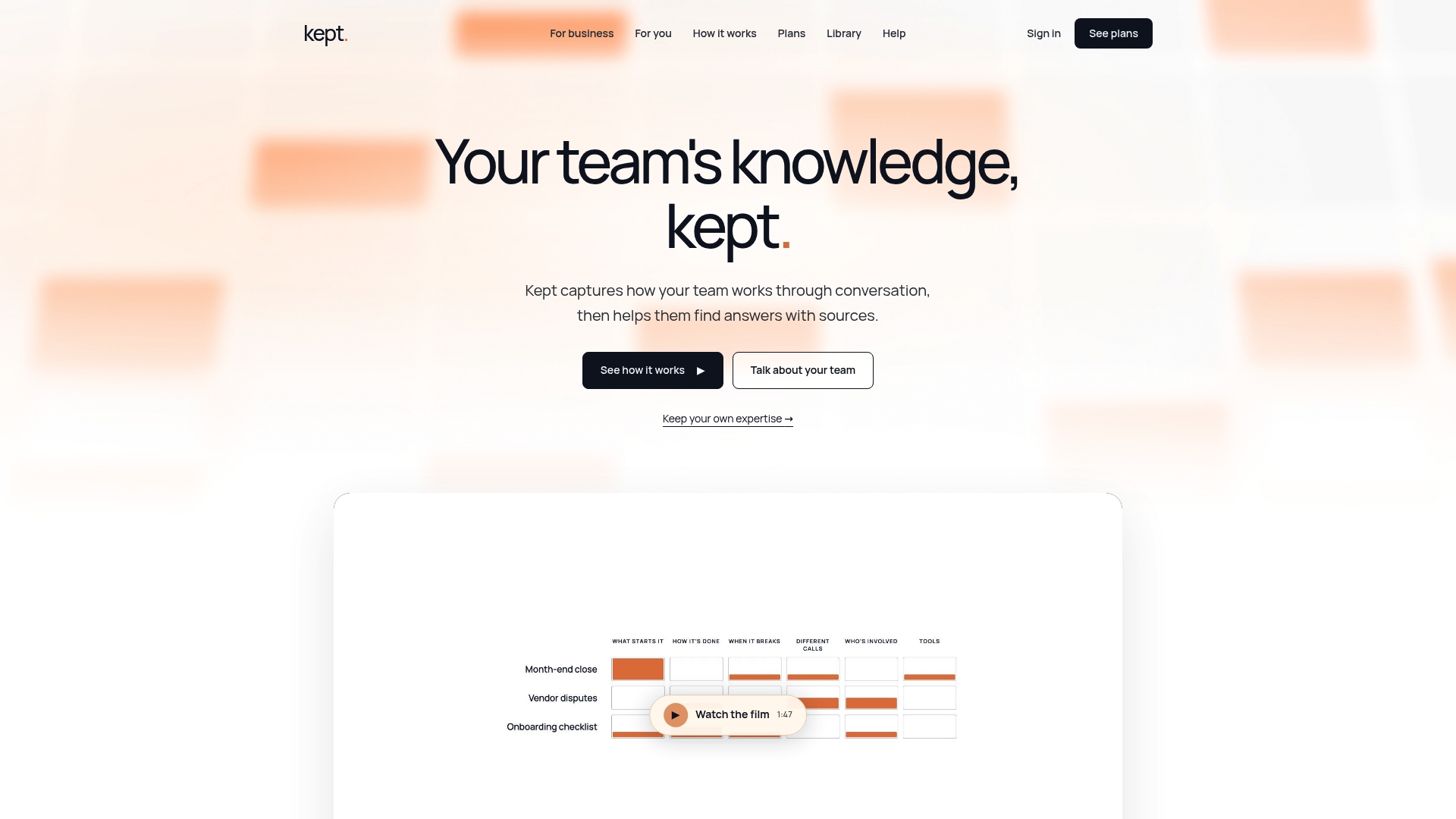
- Conversational capture that keeps an expert's own words and judgment intact
- Structured workflows generated from guided interviews, not blank-page writing
- Workspace-level access controls for opt-in, governed capture across teams
Explore Kept for Business or check pricing for kept for you and kept for business to see which plan fits your team's next pilot.
Sources
California Management Review covers mapping expertise and semantic capture. Perspectives on Medical Education details reflective VSI. MDPI's bibliometric review tracks the shift toward AI-assisted capture. Technical readers can also see a related research paper on socially interactive agents.
- Special Issue: AI and Knowledge Processes (MDPI) — bibliometric review
- Tacit knowledge is your next competitive moat (California Management Review)
- Eliciting tacit knowledge: The potential of a reflective approach to video-stimulated interviewing (Perspectives on Medical Education)
FAQ
How do you capture tacit knowledge in practice?
Start by grounding an AI-assisted conversation in artifacts the expert already produced, like tickets or decision logs, then use reflective techniques such as video-stimulated interviewing to surface the reasoning behind their choices. Embed this into regular work rather than a one-time interview so knowledge keeps flowing as situations change.
What are the three types of tacit knowledge?
Definitions vary, but a common version distinguishes technical know-how (skills gained through practice), cognitive tacit knowledge (mental models and beliefs that shape judgment), and social or relational tacit knowledge (understanding of how to work with specific people or teams). All three tend to surface best through observation or reflective dialog rather than direct questioning.
What is an example of tacit knowledge?
A support agent who can tell a genuine billing dispute from a routine question within seconds, based on subtle cues in the customer's phrasing, is a common example. That instinct rarely gets written down because the agent themselves may not consciously notice they are using it.
What does tacit knowledge mean?
Tacit knowledge is know-how and judgment that a person holds but struggles to fully explain or write down, often built through repeated experience rather than formal instruction. It sits in contrast to explicit knowledge, which is already documented and easy to transfer.
Why do knowledge capture projects usually fail?
Most failures trace back to asking experts to write documentation themselves, a slow process that rarely matches how they actually think, according to California Management Review. Projects that rely on continuous, artifact-grounded capture instead of one-time interviews tend to hold up better over time.