
A team playbook is a living document that records how your team makes decisions, runs its most important workflows, and behaves under pressure. Used correctly, it shortens onboarding, reduces coordination errors, and lets decisions stay consistent even when the people who made them are on vacation, in another meeting, or gone for good. Team leads write them, but members and managers are the ones who make them stick.
TL;DR:
- Playbooks need regular rituals like weekly checks, new-hire resets, and quarterly reviews to prevent them from becoming inactive or outdated.
- Incorporating clear decision authority and observable behaviors ensures the playbook provides actionable guidance rather than vague policies.
- Using short, targeted micro-plays for common workflows increases adoption and reduces the risk of creating lengthy, ignored manuals.
- Effective playbooks work best when built through collaborative workshops with designated owners responsible for continuous updates.
- Team cognition research shows shared understanding from documentation benefits performance more in heterogeneous or externally dependent teams.
Table of Contents
- What Belongs in a Practical Team Playbook
- How Do You Run a Workshop to Build a Team Playbook?
- How Do You Keep a Playbook From Going Stale?
- How Do You Measure Whether a Playbook Is Working?
- Templates and Micro-Plays You Can Copy Today
- What Does the Research Actually Say About Playbooks?
- Why Playbooks Turn Into Zombie Documents
- How Kept Fits Into Your Playbook
- Sources
- FAQ
What Belongs in a Practical Team Playbook
Most playbooks fail for the same reason most New Year's resolutions fail: they're written once, feel good on paper, and never touch actual behavior. A playbook that holds up is built from six components, each doing a distinct job.
- Team Charter: mission, sponsor, scope, and a version number. This is the anchor document. Public health guidance on team charters describes it as the team's official work contract, spelling out who's accountable and what "done" means.
- Roles and decision authority: who decides what, and who gets consulted versus informed. Vague ownership is the single biggest source of duplicated work.
- Operating norms with observable behaviors: not "we communicate openly" but "we respond to blocking questions within four hours during business days." If you can't picture someone on camera doing the behavior, it's fluff.
- Rituals and cadence: meeting rules, retro formats, and a recurring charter check.
- Workflows and escalation paths: short, named runbooks (micro-plays) for the handful of situations that recur and matter.
- Metrics and audit checks: how the team knows the playbook is still true.
Skip any one of these and the document tilts toward either a policy binder nobody reads or a values poster nobody can act on. The difference between documenting what people do and how they decide is exactly where most playbooks go thin.
How Do You Run a Workshop to Build a Team Playbook?
You don't draft a playbook alone at a desk. You draft it in a room (or a call) with the people who'll actually use it, because the exercises only work when they surface real disagreement, not polite consensus.
Before you schedule anything, line up three things: a sponsor who can bless the final document, a facilitator who isn't also the most senior voice in the room, and a short list of required attendees who touch the workflows you're documenting.
From there, pick a format:
- Intensive half-day: one sitting, four hours, all exercises back to back. Works well for teams under ten people who can clear a real block of time.
- Modular sprint: four 60-minute sessions spread across two weeks. Better for distributed teams or anyone who can't get a shared four-hour window.
Run these four exercises regardless of format, drawn from workshop templates built specifically for translating team values into concrete behaviors:
- Clarity Canvas: a three-column translator that turns fuzzy language ("be proactive") into specific, observable actions.
- Boundary Mapping: a traffic-light exercise sorting decisions into "team decides," "check first," and "escalate immediately."
- Zones of Authority: assigns a named owner to each recurring decision type, so authority isn't implied, it's written down.
- Breach Protocol: a short script for what happens the first time someone ignores an agreed norm.
Pro Tip: Draft roles as provisional for the first month. Time-boxing decision authority to a short trial period, rather than locking it in on day one, gets better buy-in and avoids fights over titles nobody has tested yet.
Once the workshop ends, someone owns typing the raw notes into a structured doc within 48 hours, while the exercises are still fresh, and each section gets a named owner responsible for keeping it current.
How Do You Keep a Playbook From Going Stale?
A playbook that's never touched after launch day becomes what practitioners call a zombie document: technically alive, functionally dead. Recurring rituals are what keep documented processes tied to real outcomes instead of decaying into shelfware.
- Weekly charter check: a two-minute pulse at the end of your regular team meeting. Ask one question: "Did anything happen this week that the playbook doesn't cover?"
- New-hire reset: every new team member reads the playbook in week one and flags anything confusing, which doubles as a stress test of the document itself.
- Quarterly dust-off: a scheduled 30-minute review with version numbers bumped and changes logged, plus a lightweight approval step so updates don't drift without sign-off.
- Transfer owner: one named person accountable for updates, tied to an actual deliverable, not a vague "someone should probably update this."
Skip the transfer owner and the other three rituals turn into calendar reminders everyone ignores.
How Do You Measure Whether a Playbook Is Working?
You don't need a dashboard team to prove a playbook earns its keep. You need a handful of numbers you already have access to, tracked on a simple recurring cadence.
Leading indicators tell you if the playbook is being used at all: time to competence for new hires, how often people actually open the runbook during a live incident, and audit pass rates on the quarterly dust-off. Lagging indicators tell you if it's working: cycle time on the workflows it covers, error rate on the same, and stakeholder satisfaction on outcomes the playbook governs.
- Run a two-question survey after onboarding: "Did the playbook answer your question?" and "What was missing?"
- Pull access logs on your documentation tool monthly. A runbook nobody opens is either perfect or forgotten. It's almost always the second one.
- Track pass/fail on the quarterly audit in a simple spreadsheet. No dashboard software required at this stage.
Team cognition research spanning 107 independent studies covering nearly 7,800 team members found shared knowledge structures correlate positively with performance, which is the underlying mechanism a playbook is trying to build on purpose instead of leaving to chance. Use the metrics to decide what gets rewritten next quarter, not to grade the team.
Templates and Micro-Plays You Can Copy Today

Start with a compact charter, not a fifteen-page manifesto. A workable version fits five fields: mission (one sentence), sponsor (one name), scope (what's in, what's explicitly out), success measure (one number you'll track), and version log (date, editor, what changed).
Micro-plays work the same way, kept short and named after the situation they cover:
- Incident triage micro-play: names who declares the incident, who owns customer communication, who owns the technical fix, and a 30-minute check-in cadence until resolved.
- Postmortem micro-play: scheduled within 48 hours of resolution, structured around what happened, why, and one concrete change, never around blame.
- Breach protocol: what happens the first time, second time, and third time someone skips an agreed step, with the actual conversation script included.
Apply the "camera test" to every norm you write: if you can't picture someone doing the behavior on video, rewrite it until you can. Store templates somewhere with real version control, whether that's a shared wiki, a docs folder with change history, or a workspace like Kept's business platform built around capturing the reasoning behind a workflow, not just its final steps. One micro-play adopted per sprint beats a fifty-page manual nobody finishes.
What Does the Research Actually Say About Playbooks?
Team cognition doesn't help every team equally. The meta-analysis of team cognition found the effect on performance is strongest for teams with social heterogeneity and high dependence on outside groups, meaning a tightly-knit, homogeneous team with no external handoffs gets less lift from formal documentation than a cross-functional team juggling five stakeholders.
The CIPD's evidence review on high-performing teams backs the workshop-first approach here: group-level, behavior-focused interventions with external facilitation outperform generic team-building exercises. Charters, specifically, remain underused relative to their documented value, according to the public health guidance on team charters, which recommends including a sponsor, a clear AIM statement, defined scope, and version tracking as the baseline. One practitioner tip worth repeating: test drafted roles in a short experiment before treating them as permanent.

Why Playbooks Turn Into Zombie Documents
Playbooks die for one reason: nobody's job depends on them staying alive. No owner, no stakes, no reason to open the file again after launch week.
The fix that actually works is unglamorous. Tie version updates to a transfer owner's real deliverable, then audit that deliverable out loud in a recurring meeting, not in a spreadsheet nobody checks. Documentation systems built around conversational capture, rather than static templates, tend to surface this problem faster, since a workflow tool that captures reasoning in someone's own words also exposes exactly when that reasoning has gone stale.
— Anthony
How Kept Fits Into Your Playbook
A playbook only works if it captures the reasoning behind a decision, not just the decision itself. That's the gap Kept is built to close. Instead of asking someone to write a runbook from scratch, Kept runs a guided conversation and turns what they say, including the exceptions and judgment calls that never make it into a static doc, into a structured workflow.
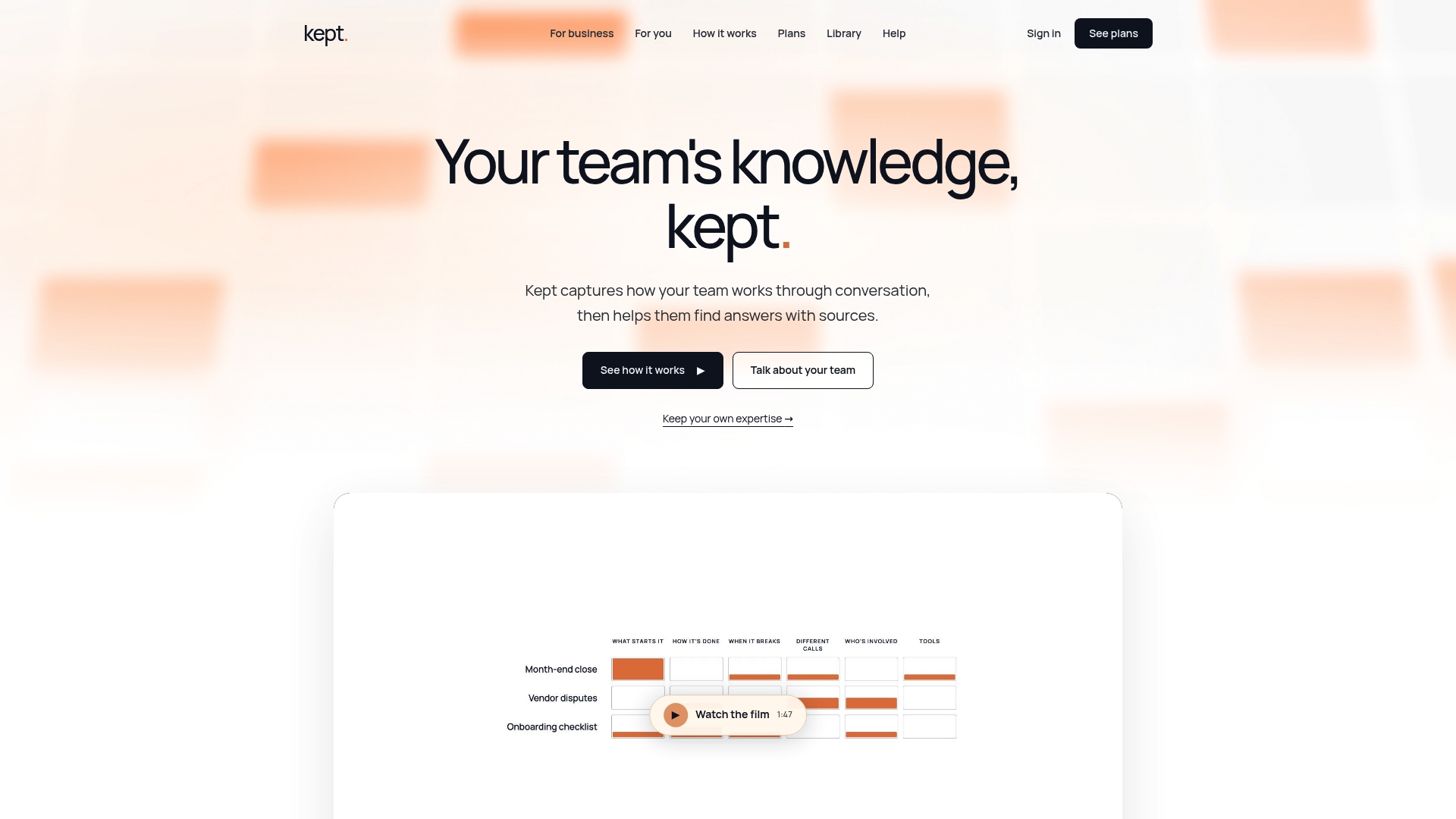
That matters most in three places: onboarding new hires against what the team already knows instead of a stale wiki page, preserving the tacit knowledge a departing employee would otherwise walk out the door with, and building runbooks that reflect how work actually gets done under pressure, not how it was supposed to go in theory. Kept for Business gives teams workspace-level access controls and opt-in capture, so knowledge stays owned by the organization rather than locked in one person's head. Individuals documenting their own expertise can start with Kept for You. Check current plans and pricing to see which workspace fits your team, or join the live session on September 15 to see the guided capture process firsthand.
Sources
The playbook guidance here draws on a handful of sources worth reading directly if you're building your own facilitation plan. The team cognition meta-analysis is the strongest evidence base for when shared documentation actually moves performance. The CIPD evidence review on high-performing teams covers what makes team-building interventions stick versus fade. The Team Charter guide and the workshop agenda and exercise templates give you the actual facilitation scripts referenced in the workshop section above.
- Conditioning team cognition: A meta-analysis
- High-performing teams: practice summary (CIPD)
- The Team Charter (public health guidance)
- Team Charter Workshop Guide: Agendas, Clarity Canvas & Exercises
- Knowledge Transfer Guide: Scale Distributed Teams in 2026
FAQ
What Are the Different Types of Team Playbooks?
Most teams need three types: a Team Charter covering mission and authority, operating playbooks covering norms and rituals, and micro-plays covering specific recurring workflows like incident response or onboarding. Larger organizations sometimes layer a company-wide playbook on top, but the charter and micro-plays do most of the daily work.
What's the Best Format for a Team Playbook?
The best format is whichever one your team will actually reread, which usually means a short living document with clear version numbers rather than a long static manual. A compact charter paired with a handful of named micro-plays, stored somewhere with real version history, consistently outperforms a single sprawling document nobody finishes.
What Does "Playbook" Mean in a Team Context?
A team playbook is a documented reference for how a team decides, communicates, and executes its recurring work, covering roles, norms, escalation paths, and rituals. It differs from a standard operating procedure by including judgment calls and exceptions, not just fixed steps.
Can You Give an Example of a Team Playbook in Practice?
A customer support team's playbook might include a charter defining response-time targets, a micro-play for escalating angry customers with named roles and a timeline, and a weekly two-minute charter check at the end of the team meeting. Tools built for capturing decisions in a team's own words show how this plays out across support, RevOps, and HR teams differently.
How Much Does Kept Cost for a Team?
Kept offers both a personal plan (Kept for You) and a business workspace plan (Kept for Business), and current pricing for each is available on the Kept pricing page.