

Project handover documentation is the complete record a project team hands to whoever operates, maintains, or benefits from the work next, and it is only finished when three things exist together: a named owner, documentation that receiver can actually find and verify, and signed acceptance against clear criteria. The bundle typically includes scope and deliverables, a responsibility matrix, operational runbooks, contacts and access details, and an open issues log. Done looks like a steward who can answer questions without calling you.
TL;DR:
- A complete handover package must include clear scope and deliverables with verifiable acceptance criteria, signed off by the client or sponsor.
- Responsibility matrices should attach specific owners, deadlines, and dependencies to all outstanding tasks to ensure accountability.
- Operational manuals require detailed build, deployment, configuration, and rollback procedures to support long-term system maintenance.
- Handover documentation should be written for end users, with quick-start guides and accessible formats, emphasizing practical actions over explanations.
- Continuous knowledge capture, dry runs, shadowing, and early planning are critical to a successful transition and prevent last-minute gaps.
Table of Contents
- Core components every handover bundle must include
- Template outlines and short examples: checklist, report, transition plan, sign-off
- Step-by-step execution: plan, prepare, transfer, verify
- Technical and IT handover specifics: operations guides, SLAs, and transition milestones
- Writing and structuring documents so receivers can actually use them
- Capture lessons learned as you go: practical templates and governance
- What the author gets right, and what templates still miss
- Why most handover checklists are necessary but not sufficient
- Where Kept fits next to your handover templates
- Sources
- FAQ
Core components every handover bundle must include
Most handover packages fail for a boring reason: they are written for the person leaving, not the person arriving. The receiving team doesn't need a history of the project. They need to know what exists, who owns it now, and how to prove nothing was missed. APM's research into successful handovers treats handover as a process that starts at project initiation, not a single date stamped on a calendar, and that framing should shape what you build into the bundle from day one.
A complete handover package covers five categories, each answering a different question the receiving team will ask in its first week.
- Scope and deliverables with acceptance criteria: what was promised, what was delivered, and the sign-off fields that prove the client or sponsor agreed it was done.
- Timeline, outstanding actions, and a responsibility matrix: who owns each open item now, with deadlines attached instead of left vague.
- Operational runbooks and system mapping: the maintenance manual, configuration details, and diagrams that let someone else run the thing without calling you.
- Contacts, access, and credentials: vendor numbers, admin logins, license keys, and who holds each one.
- Open risks, issues, change log, and contracts: anything still unresolved, plus the paper trail that explains why decisions were made.
The scope and deliverables section is where most teams get lazy, listing what was built without stating how anyone can verify it was built correctly. Acceptance criteria should be specific enough that a stranger could check a box: "load test passed at 500 concurrent users," not "performance is good." Attach a sign-off field next to each major deliverable so approval isn't buried in an e-mail thread six months later.
The responsibility matrix deserves more attention than it usually gets. A list of outstanding tasks without owners is just a wish list. Every open item needs a name attached, a deadline, and a note on what happens if that deadline slips. This is also where you record dependencies: if task twelve can't start until task nine closes, say so, because the receiving team won't know your project's internal logic unless you write it down.
Operational runbooks matter more for technical projects, but even non-technical handovers benefit from a short "how this actually runs" document. Think of it as the equivalent of an oral history interview: you're capturing not just the steps but the reasoning behind them, the same way an investigative journalist records context around a quote rather than just the quote itself.
Contacts and access information gets forgotten until someone is locked out of a system during an emergency. List every vendor, every login, every license renewal date, and who currently holds administrative rights. Finally, the open risks and change log section should read like a ledger, not a narrative: what's unresolved, what changed and why, and which contracts or licenses are still active and need renewal attention.
Template outlines and short examples: checklist, report, transition plan, sign-off
You don't need custom software to build a usable handover package. Four documents, each built around a simple outline, cover almost every handover scenario.
- Handover checklist. Build a table with five columns: item, owner, status, evidence, and date completed. Each row is one deliverable or action; the evidence column should link to the actual file, test result, or approval, not just a checkmark. This single table becomes your audit trail if anyone asks later what was verified and when.
- Handover report. Structure it in four sections: an executive summary (two or three sentences on what was delivered and where things stand), scope and status (what was planned versus what was completed), outstanding items and risks (with owners), and recommendations for the receiving team (what to watch, what to fix first, what to ignore).
- Transition or knowledge-transfer plan. Lay out a schedule of sessions, each with a stated owner, a topic, and an acceptance gate. For example: week one covers system architecture walkthroughs led by the lead developer, with acceptance gated on the receiving engineer being able to explain the deployment pipeline unprompted. Week two covers operational procedures, gated on a successful dry run. This schedule turns "we'll explain things as we go" into something measurable.
- Client or sponsor sign-off form. Keep it short: a summary of what's being accepted, the specific acceptance criteria being confirmed, a signature or digital approval field, and a date. For formal projects, this form should match whatever approval process your contract or governance framework already requires, whether that's a wet signature, an e-mail confirmation, or a digital signature tool.
These four documents work together rather than separately. The checklist feeds the report, the report informs the transition plan's priorities, and the sign-off form closes the loop. Skip any one of them and you leave a gap: a checklist without a sign-off has no proof of acceptance, and a transition plan without a checklist has no way to verify the sessions actually happened as planned.
Keep every template in an editable, shared format. A PDF scan of a handwritten checklist is worse than no checklist at all, because it looks complete while being nearly impossible to update or verify later.
Step-by-step execution: plan, prepare, transfer, verify
Handover is not a task you do in the last week of a project. It's a thread that should run through the whole timeline, and teams that treat it that way end up with far less last-minute scrambling.
- Plan for handover at project initiation. Add handover tasks directly into the work breakdown structure instead of bolting them on at the end. Identify who the eventual receiver will be as early as possible, even if that person hasn't been assigned yet, because APM's guidance on successful handovers points to agreeing information requirements at the outset as one of the clearest predictors of a smooth transition.
- Capture knowledge continuously, not at the end. Build short knowledge-capture tasks into every phase review rather than waiting for a single closeout session. Real-time capture keeps details accurate; memory fades fast, and a lesson written two weeks after it happened is already thinner than the one written the same day.
- Run dry runs, training, and shadowing before the formal transfer. Have the receiving team operate the system or process while the original team is still available to answer questions. Shadowing surfaces the small judgment calls that never make it into a written procedure, the kind of tacit reasoning that documentation alone tends to miss.
- Verify acceptance against stated criteria, then build in a support window. Don't treat the sign-off form as the finish line. Agree on a defined period, often two to four weeks, where the original team remains reachable for questions. This protects against the common failure mode where the receiving team discovers gaps only after the original team has scattered to other projects.
Pro Tip: Schedule your dry run at least one week before the formal handover date, so you have time to fix whatever it reveals instead of discovering problems on the day the receiving team takes over.
The biggest mistake in this sequence is skipping step three. Teams under deadline pressure often jump straight from documentation to sign-off, assuming that written procedures are enough. They rarely are. A procedure document tells someone what to do; shadowing shows them what to do when the procedure doesn't quite fit the situation in front of them, which is exactly when problems tend to surface.
Verification deserves its own discipline too. Don't just ask the receiving team if they're comfortable. Ask them to demonstrate a task from the documentation without help. If they can't, the documentation isn't done yet, no matter how complete it looks on paper.
Technical and IT handover specifics: operations guides, SLAs, and transition milestones
IT and technical projects carry extra weight because the gap between "delivered" and "maintainable" is often wider than anyone budgets for. A system that works perfectly during final testing can become unmanageable within months if the maintenance team never received the information they needed to support it.
The core document here is the operations and maintenance manual, and it needs to cover more than most teams assume:
- How to build the system from source, including dependency versions and build tools, not just a description of what it does.
- Where to find the code, with repository links, branch naming conventions, and who has commit access.
- Compile and deployment steps, written as a sequence someone unfamiliar with the project could follow without guessing.
- Configuration details, including environment variables, feature flags, and any settings that differ between staging and production.
- Rollback procedures, so the maintenance team has a tested path back to a known-good state if a deployment fails.
PMI's guidance on project closeout recommends adding six specific transition activities to the closeout phase of IT projects, designed to bridge the gap between the development team and the team that will maintain the system long term. These activities should be scheduled into the work breakdown structure as real tasks with owners and deadlines, not treated as informal conversations that happen if there's time.
Before the formal handover, draft a first service-level agreement and an ownership matrix, even in rough form. A new system without an SLA tends to fall into a gap where no one is quite sure who's responsible for a two in the morning outage. Put a draft in front of both teams early enough that it can be negotiated rather than imposed at the last minute.
Open defects need their own handoff path. Hand over the full defect tracking database, not a summary spreadsheet someone compiled in a hurry. The maintenance team needs the original ticket history, priority labels, and any notes on attempted fixes, because a defect that looks minor in a summary might have a complicated history that matters to how it gets resolved. Kept's resources for engineering managers look at this exact gap: closing out a technical project cleanly enough that the team picking it up can actually operate and support it.
Writing and structuring documents so receivers can actually use them
Documentation written for the author's own memory reads completely differently from documentation written for a stranger. Most handover packages fail here before they fail anywhere else: they assume context the receiver doesn't have.
The fix is a simple authoring rule: write for the end user, and put the action before the explanation. A quick-start section should tell someone what to do in the first five minutes with the system, not walk them through architecture decisions made eighteen months earlier. Save the deeper detail for a second layer.
- Quick-start guide: the first page or two, covering the most common actions and any emergency procedures.
- Operational detail: the full runbook, covering less common tasks and edge cases.
- Reference annexes: architecture diagrams, decision logs, and anything useful for troubleshooting but rarely needed day to day.
APM's handover research found that documentation needs to be written for end users and stored somewhere accessible, specifically recommending a common data environment over scattered personal drives, because documents populated early and kept in one shared location avoid the kind of last-minute data dump that nobody can actually use.
A common data environment matters more than most teams realize. A shared, single-source location for handover files prevents the all too common scenario where three people each hold a slightly different version of the "final" document.
Avoid niche file formats that require specific software the receiving team may not have. Stick to widely readable formats, use version control so changes are tracked, and set access rights so the right people can edit while others can only view. ISO's guidance on documented information requires organizations to maintain documentation "to the extent necessary" to support operations and to retain evidence that processes were carried out as planned, with the right level of detail depending on the organization's size and complexity rather than a fixed universal standard. That guidance also implies a minimum retention discipline: documents need version control and a clear owner for updates, not a one-time creation date and no maintenance plan after that.
Capture lessons learned as you go: practical templates and governance
Lessons learned sections are the most skipped part of any handover, usually because they get pushed to the very end of the project, by which point half the details are already forgotten.
PMI's guidance on lessons learned is blunt about the fix: capture lessons early and often, integrated into each phase rather than reserved for a single closeout meeting. Build a short lessons review into every phase gate and regular progress meeting, so capture becomes a habit rather than an event.
A lightweight lessons log needs only a handful of fields to be useful:
- Category: what area the lesson relates to, such as scheduling, vendor management, or technical design.
- Lesson and root cause: what happened and why, in plain language.
- Action and owner: what should change next time, and who is responsible for making that change happen.
- Keywords: a few searchable terms so the lesson surfaces later when someone searches the repository.
A short post-implementation review, held a few weeks after go-live, catches issues that only show up once the system is under real use rather than test conditions. Track whether anyone actually searches the lessons repository afterward: a log nobody opens again isn't governance, it's an archive.
Pro Tip: Assign every lesson an owner for the follow-up action, not just a category. A lesson with no owner tends to get logged once and never acted on.
Link lessons to specific process changes wherever you can. A lesson that says "communication was unclear" is nearly useless. A lesson that says "weekly status e-mails should include a one-line risk flag, owned by the PM starting next sprint" actually changes how the next project runs. Kept's resources for operations managers cover why starting this habit early, and keeping it running through the whole project, tends to produce far more usable knowledge than a single retrospective at the end.

What the author gets right, and what templates still miss
The author of this guide, Anthony, has spent enough time inside handover packages to know the pattern: the checklist gets filled in, the sign-off gets signed, and six months later someone still calls the original project manager because the document doesn't explain why a decision was made, only that it was made.
Kept exists because of that gap. The product lets people describe their own processes conversationally, in their own words, and turns that into structured documentation, including the exceptions and reasoning that a static template rarely captures. Kept's overview of what gets lost when someone leaves a role describes this clearly: the documentation can list the steps, but it misses how the person actually decided between option A and option B when the standard procedure didn't quite apply. That's the part a written procedure tends to miss entirely, and it's usually the part the receiving team needs most in their first difficult week.
— Anthony
Why most handover checklists are necessary but not sufficient
A checklist tells you a task was completed. It does not tell you why the person chose to do it that way, and that gap is where most post-handover confusion actually lives. The standards bodies agree on this more than practitioners act on it: APM frames handover as a process, PMI insists lessons be captured in real time, and ISO ties documentation quality to organizational judgment rather than a fixed template. None of that advice says "skip the paperwork." It says the paperwork alone was never going to be enough.
The conventional advice leans hard on structure: better templates, more thorough checklists, tighter sign-off gates. That's useful, but it treats documentation as a storage problem when it's often a translation problem, converting what's in someone's head into something another person can act on without that first person in the room.
If you take one thing from this guide, prioritize the conversations over the paperwork. Build the templates, but spend more of your remaining time on shadowing, dry runs, and direct questions than on polishing the document itself.
Where Kept fits next to your handover templates
Templates and checklists do most of the work for scope, timelines, and acceptance criteria, and you should build those first. They fall short on one specific thing: capturing the reasoning behind a decision, the exception someone made without writing it down, the judgment call that only lives in one person's head.
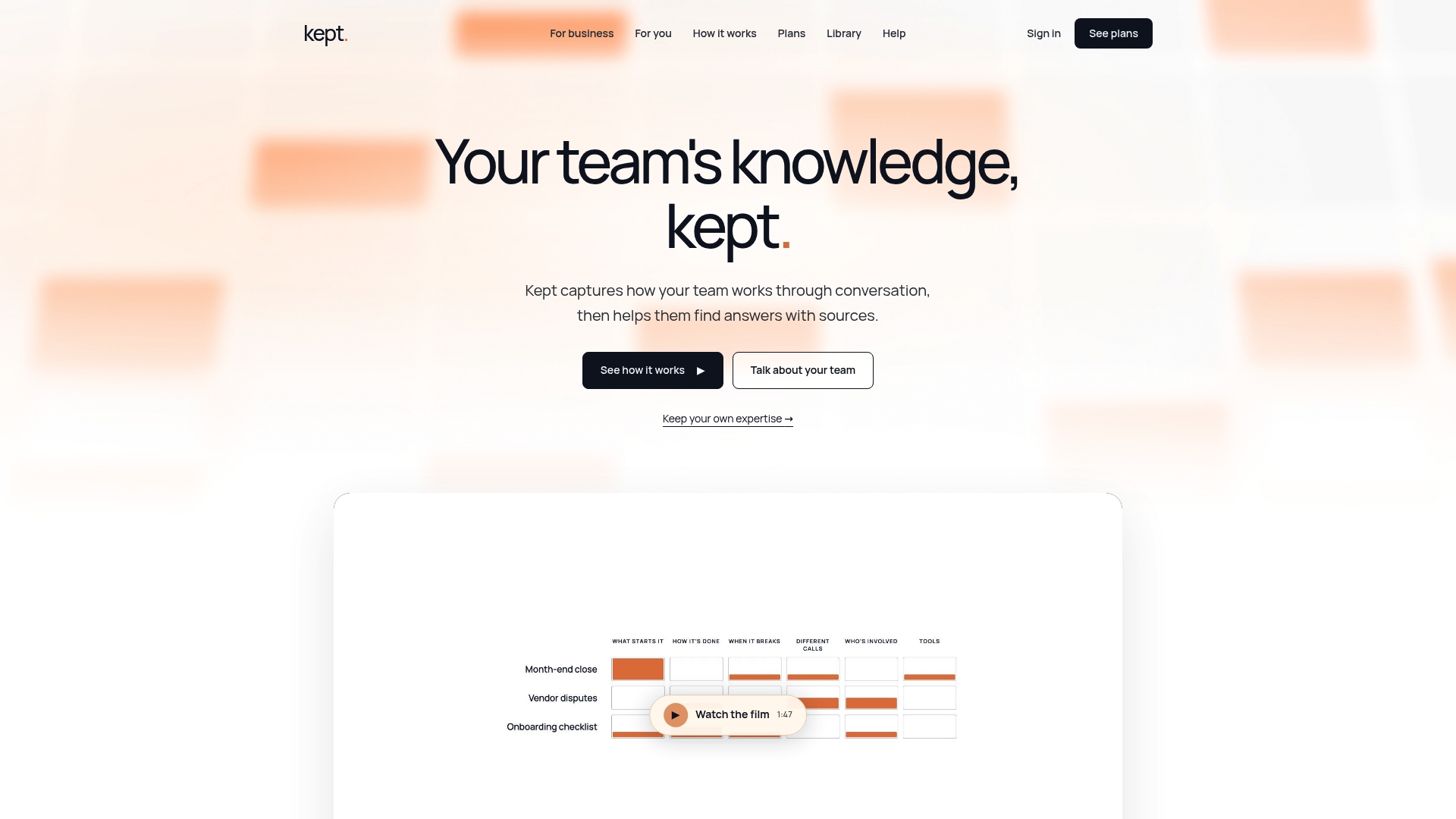
Some solutions are built for that gap. Instead of asking someone to write a procedure document from scratch, they let people talk through their process conversationally and turn that into structured, searchable documentation, preserving the context and exceptions that a standard template tends to flatten out. Business workspaces may add access controls so the right people on a team can search and reuse that knowledge, with opt-in capture and review so nothing gets recorded without consent.
If your handover package already has solid checklists and sign-off forms but you're worried about what walks out the door when someone leaves, kept for business is worth a look alongside your existing templates. Check current plans and pricing to see which workspace fits your team.
Sources
- 12 factors for the successful handover of projects — APM
- Project closeout: maintenance as a critical transition — PMI
- Guidance on the requirements for Documented Information — ISO
FAQ
What should be in a project handover document?
A project handover document should cover scope and deliverables with acceptance criteria, a timeline of outstanding actions with named owners, operational runbooks or maintenance manuals, a full contacts and access list, and an open risks and change log. The exact mix depends on the project type, but APM's handover research emphasizes agreeing on these information requirements early rather than assembling them at the last minute.
How do you write a good handover document?
Write for the person receiving the project, not for your own memory: lead with quick-start actions, then add operational detail, then reference material for edge cases. Keep the document in a shared, common location using widely readable formats, and attach evidence or sign-off fields to each major item so acceptance is provable later.
How do you do a handover of a project?
Start planning the handover at project initiation by adding handover tasks into the work breakdown structure, then capture knowledge continuously through phase reviews rather than waiting until the end. Run dry runs and shadowing sessions before the formal transfer, and verify acceptance against stated criteria with a defined support window afterward.
What is a handover checklist?
A handover checklist is a simple table listing every deliverable or action with columns for item, owner, status, evidence, and date completed. It acts as an audit trail showing what was verified and when, and it works best when linked directly to the actual files or test results rather than filled in with a plain checkmark.