
Process change control is the formal system organizations use to evaluate, approve, implement, and verify any modification to a process before it goes live. The workflow runs in five stages: initiate, assess, approve, implement, verify. Done well, it prevents scope creep, cuts operational risk, and leaves an audit trail that shows exactly who decided what, and why.
TL;DR:
- Most changes should be categorized into three risk levels: major, minor, or inconsequential, influencing the thoroughness of impact analysis and approval pathways.
- Impact evaluation is critical to catch weak proposals early, assessing affected systems, compliance needs, and safety considerations before approval.
- All approvals, rejections, and conditions must be logged with a timestamp and responsible person, with verbal approvals strictly forbidden to avoid disputes.
- Validation, safety reviews, rollback plans, and proper documentation are necessary to confirm a change works as intended before closure.
- Tools that capture and preserve decision reasoning, such as guided conversation platforms, help maintain a clear audit trail and onboard new reviewers faster.
Table of Contents
- How Does the Process Change Control Workflow Work?
- Who Approves Changes, and Who Runs the Board?
- How Do You Categorize a Change's Risk Level?
- What Controls Verify a Change Before Closure?
- What Best Practices Keep a Change Program Healthy?
- What Tools and Documentation Practices Reduce Risk?
- Where Change Control Programs Usually Break
- A Better Way to Capture the Reasoning Behind Every Change
- Sources
- FAQ
How Does the Process Change Control Workflow Work?
Every change control system, from a pharmaceutical plant to a software team, moves through the same five stages. The names shift by industry, but the logic underneath is identical.
- Initiation. Someone submits a change request with a clear problem statement, proposed solution, business justification, and target timeline. A request missing any of these is not ready for review. It gets kicked back.
- Impact evaluation. A qualified reviewer maps the scope: which systems, teams, products, or customers touch this change, and whether compliance or safety requirements apply. This is where most weak proposals get caught before they waste anyone's time.
- Approval decision. The designated approver or board issues one of three outcomes: approve, reject, or approve with conditions (a specific test result, a revised rollback plan, a training deadline). Conditional approvals are common and should always name the exact condition and who verifies it.
- Implementation planning. This covers scheduling, resourcing, and communication. Anyone affected by the change needs advance notice, and anyone operating under the new process needs training before go-live, not after.
- Verification and closure. The team confirms the change performs as intended, using pre-agreed acceptance criteria, then formally closes the record.
Industry guidance from the AATB's change control best practices resource breaks this down into three broader phases (assessment, development, implementation) and insists on a dedicated change control file for each request, not a scattered email trail.
What separates a functioning system from a paper exercise is the required fields at intake:
- Problem or opportunity statement
- Proposed change and alternatives considered
- Business or safety justification
- Requested implementation date
- Systems, teams, and documents affected
Skip the justification field and you get a backlog full of changes nobody remembers the reason for six months later.
Who Approves Changes, and Who Runs the Board?
Good governance is not about adding layers. It is about putting the right person in front of the right decision, fast.
The Change Management Lead owns the process itself: intake quality, routing, tracking status, and making sure nothing sits unreviewed. Many organizations pair this role with a change champion embedded in the operating team, someone who understands the day-to-day process well enough to flag a bad idea before it reaches formal review.
The Change Advisory Board (CAB) convenes for anything above a defined risk threshold. Composition matters more than most teams realize. A board stacked with technical leads alone will miss downstream effects that a security, quality assurance, or customer operations representative would catch immediately. Cross-functional membership is what keeps a CAB useful rather than ceremonial.
- CAB reviews scheduled changes on a fixed cadence (weekly or biweekly works for most mid-size operations).
- Emergency changes get an expedited path: a smaller quorum, tighter documentation, and a mandatory retrospective review within days.
- Every decision, approval, rejection, or condition gets logged with a timestamp and the approver's name.
Pro Tip: Give your CAB a hard rule: no verbal approvals. If a decision isn't logged in the change record, it didn't happen. This single habit eliminates most disputes about who authorized what.
How Do You Categorize a Change's Risk Level?
Not every change deserves the same scrutiny, and treating a label update the same as a safety-critical modification is how teams burn out their review process. Most mature systems sort requests into three tiers.

Major changes touch product quality, regulatory standing, safety systems, or reach across multiple departments or customer-facing systems. These require full impact analysis, formal validation, and CAB sign-off.
Minor changes affect a single system or team with low risk exposure. These often follow a lightweight approval path, one qualified reviewer instead of a full board.
Inconsequential changes, sometimes called replacement-in-kind (RIK), swap one component or step for a functionally identical equivalent with no change in specification, supplier qualification, or output. A like-for-like part replacement from an already-approved vendor is a textbook RIK example. It still gets logged, but it does not need the full assessment machinery.
A practical risk checklist covers:
- Environmental, health, and safety exposure
- Data security or access implications
- Direct customer or product impact
- Regulatory or compliance touchpoints
- Number of downstream systems or teams affected
One KPI worth tracking closely is the aging of open changes. Practitioners in the IChemE management of change guidance recommend re-running the impact analysis on any request that sits open too long, because conditions on the ground shift and a stale assessment can approve a change against facts that no longer apply.
What Controls Verify a Change Before Closure?
A change is not done when it goes live. It is done when someone proves it works as intended and the paperwork says so.
- Validation planning. Regulated environments often require Installation Qualification, Operational Qualification, and Performance Qualification (IQ/OQ/PQ) before a change touches production. Not every change needs this level of rigor. But any change affecting product quality, safety systems, or regulated output usually does.
- Pre-Start Safety Review (PSSR). Before go-live, a PSSR confirms the physical and procedural environment is actually ready, not just planned to be ready. The AIChE Center for Chemical Process Safety guidance recommends matching PSSR checklist length (short form versus long form) to the scope of the change rather than applying one template to everything.
- Rollback planning. Every implementation plan needs a defined trigger for reversal, who calls it, and how affected teams get notified if the change gets pulled.
- Closure evidence. The change record closes only when it contains updated SOPs, training completion records, test or validation reports, and the full change package.
Closure documentation is not bureaucratic padding. Regulatory enforcement actions, including FDA warning letters, routinely cite missing or incomplete change records as the root failure behind larger compliance breakdowns.
- Test reports and acceptance criteria results
- Updated procedure documents
- Training sign-off records
- Final approval signatures with dates
What Best Practices Keep a Change Program Healthy?
The programs that survive past year one share a few habits. The ones that collapse almost always skipped these.
Scale the process to the risk. A low-impact change should move through a lightweight path in days, not weeks. Full MOC gating belongs on high-impact changes only, or your team starts routing around the process entirely, which defeats the purpose.
- Track approval time, count of open changes, and success rate (changes closed without rollback) monthly.
- Use real near-miss examples in training instead of abstract policy language. The AIChE/CCPS guidance found that management reinforcement paired with concrete case studies does more for adoption than any written policy alone.
- Keep a short communication template ready: what changed, why, who approved it, and what the affected team needs to do differently.
Pro Tip: If your CAB starts rubber-stamping requests to clear a backlog, that's not efficiency. That's the early sign of MOC fatigue, and it usually means your intake criteria let too many low-value requests in.
What Tools and Documentation Practices Reduce Risk?
A change package earns its name when it holds the full story: the rationale, the impact analysis, test evidence, training records, and every artifact the change touched. Miss the rationale and you have a record of what happened with no trace of why anyone thought it was a good idea, which is exactly the gap that shows up when the person who approved it leaves the company.
This is where guided, conversational capture earns its place next to standard SOP templates. A platform like Kept lets the approver or process owner describe exceptions and edge cases in their own words during intake, preserving judgment calls that a checkbox form would flatten. When you evaluate any documentation tool for this purpose, check its security posture:
- Data handling and access controls, covered on Kept's security page
- Subprocessor transparency, listed at Kept's subprocessors page
- Published uptime and incident history, visible on Kept's status page
Standard documentation captures what changed. It rarely captures how the decision got made, which is the exact gap guided capture is built to close.
Where Change Control Programs Usually Break
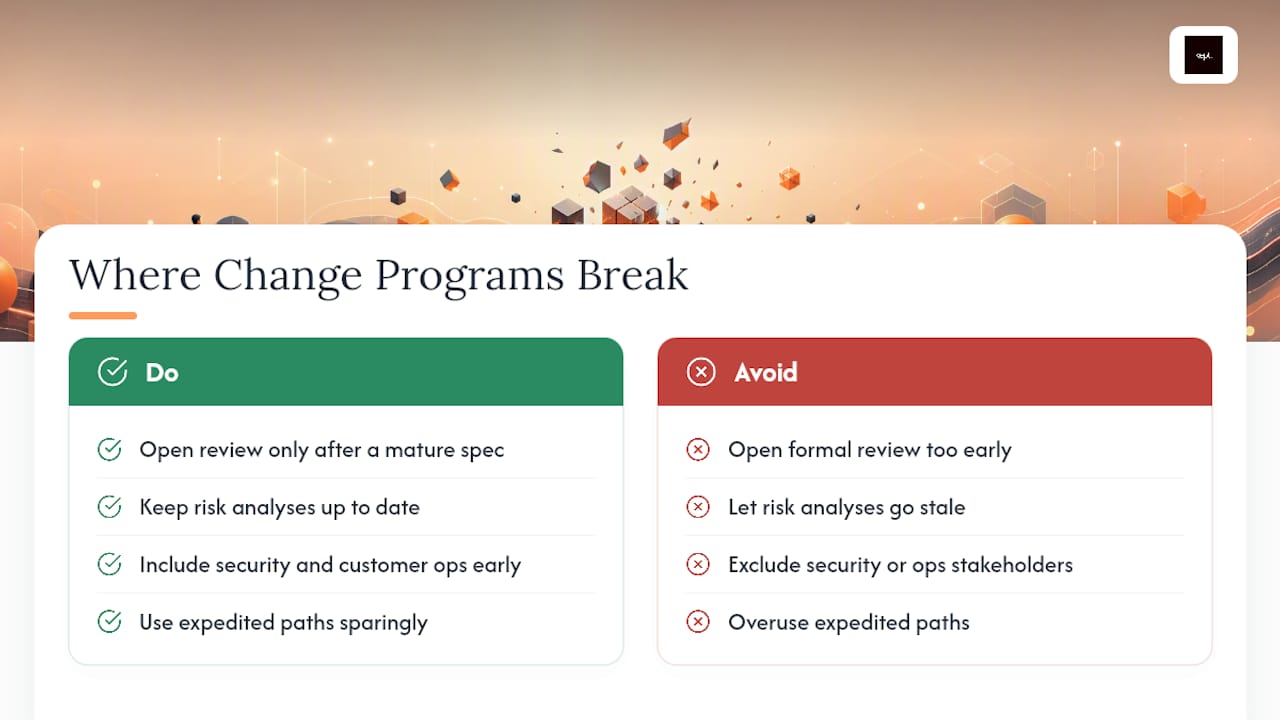
The most common failure is opening formal review too early, before a proposal has a mature technical spec or a real implementation plan. That turns the CAB into a brainstorming session instead of a decision body, and it burns credibility fast.
The second failure is letting analyses go stale. A risk assessment written eight weeks before implementation may no longer reflect reality. And the third is quietly leaving out a stakeholder who should have flagged an issue early, usually security or customer operations, because the CAB was built around technical roles alone. Expedited paths exist for genuine emergencies. Use them sparingly, or they stop meaning anything.
— Anthony
A Better Way to Capture the Reasoning Behind Every Change
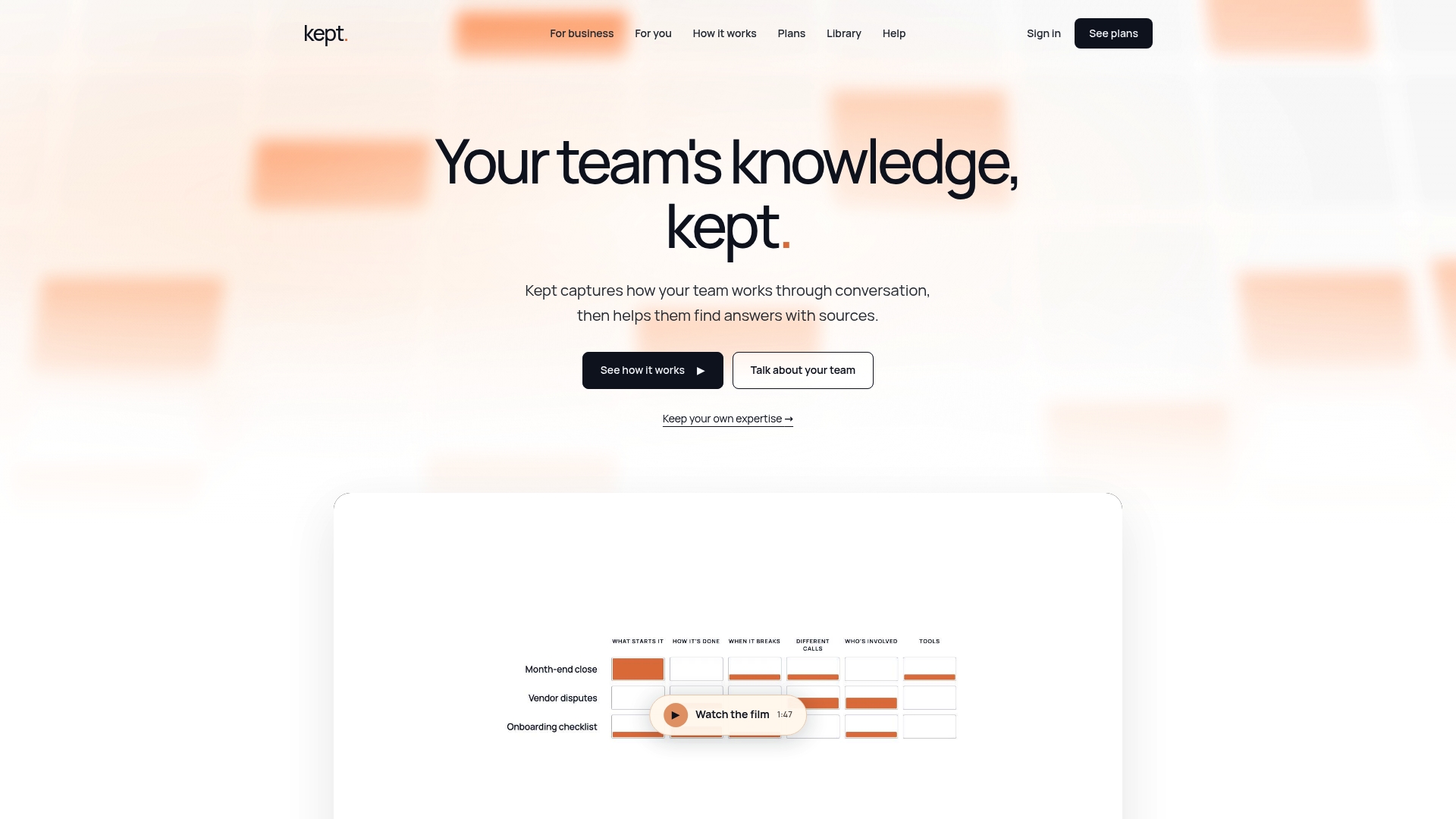
Most change control programs are good at capturing what happened. They are far weaker at capturing why, which is exactly the record that vanishes when the person who approved the change moves to a different role or leaves the company. Kept closes that gap by letting process owners talk through a change in their own words, guided conversation instead of a blank form, and turning that explanation into a structured record that includes the exceptions and judgment calls a standard template would flatten.
For teams building or scaling a formal change program, that means onboarding new reviewers faster and giving auditors a real rationale trail instead of a checkbox history. If you manage a team's process documentation and want to see how this fits your change control program, review Kept's plans for individuals and business teams or explore what Kept for Business offers for teams managing shared knowledge. And if your organization is rolling out AI tooling alongside process changes, Yesper's guidance on avoiding rollout shelf-ware is worth pairing with your governance plan.
Sources
FAQ
What Is the Difference Between Change Control and Change Management?
Change control is the technical procedure for evaluating, approving, and documenting a specific modification. Change management is the broader discipline of helping people adopt that change, covering communication, training, and sponsorship, as Prosci's framework explains through its ADKAR model. A program needs both; change control without adoption support tends to produce approved changes nobody actually follows.
What Are the Steps in the Change Control Process?
The standard workflow runs through initiation, impact assessment, approval, implementation, and verification with formal closure. Some organizations split this into six steps by separating planning from execution, but the core logic, propose, assess, decide, execute, confirm, stays the same across industry guidance.
What Are the FDA Requirements for Change Control?
The FDA's Quality System Regulation requires manufacturers of regulated devices to maintain documented procedures for evaluating and approving changes, including validation evidence before implementation. Details on these expectations appear in the FDA's Quality System Regulation, and enforcement gaps regularly show up in published FDA warning letters.
How Do You Categorize the Severity of a Process Change?
Most systems sort changes into major, minor, and inconsequential (replacement-in-kind) tiers based on safety, regulatory, quality, and reach considerations. A major change touching product safety or compliance gets full board review; a like-for-like part swap from an approved vendor typically needs only a log entry.
How Does Kept Help Document Process Changes?
Kept lets process owners describe a change and its reasoning through guided conversation, then turns that into a structured record that preserves exceptions and judgment calls. Pricing details for individual and business plans are available on Kept's pricing page.