
Knowledge lifecycle management is the set of repeatable practices and governance that turn individual expertise into reusable organizational capability. It draws on standards like ISO 30401:2018, techniques like communities of practice, and newer tools like Kept's conversational capture to shorten onboarding, sharpen decisions, and stop expertise from walking out the door with departing staff. What follows maps each stage to the actions that actually move it.
TL;DR:
- Effective knowledge management depends on assigning clear ownership roles and integrating guided conversational capture to preserve tacit reasoning.
- Success metrics include increasing knowledge reuse rates, reducing retrieval times by up to 68%, and shortening onboarding durations through structured processes.
- Organizations should focus on governance, consent, and regular review schedules to prevent outdated content and build trust in their knowledge systems.
- Scaling should start with pilot projects in critical domains, using targeted metrics and incremental expansion to avoid overwhelming the system early on.
- Technology choices should prioritize search quality, accurate metadata, and integration with existing systems over feature lists to maximize value.
Table of Contents
- The six stages of the knowledge lifecycle
- How MIT Sloan, KM maturity models, and ISO 30401 fit together
- Building the playbook: roles, tactics, and technology by stage
- Measuring maturity: the KPIs that prove KM is working
- Governance, consent, and the mistakes that sink KM programs
- Where conversational capture fits: preserving the reasoning, not just the rule
- Your first 180 days: a prioritization checklist
- Why most KM programs stall, and how to fix it
- How Kept operationalizes knowledge lifecycle management
- Sources
- FAQ
The six stages of the knowledge lifecycle
Most organizations already do some of this work. They just do it unevenly, favoring the stages that are easy to see over the ones that quietly determine whether any of it sticks.
Creation is where new insight enters the system: a technician solves an unusual fault, a salesperson figures out how to handle an objection nobody trained them on. The goal here is simple recognition, noticing that something worth keeping just happened. Capture and codification turns that tacit moment into something explicit: a note, a recorded explanation, a documented exception. This is the stage most companies skip, because it requires someone to stop and ask "how did you actually do that," not just "what's the procedure."
Organization and storage gives captured knowledge a home and a structure so it can be found later. A taxonomy that maps to how people actually search beats a folder structure that maps to your org chart. Sharing and distribution moves knowledge from where it lives to where it's needed, through search, onboarding materials, or a colleague who knows who to ask. Application is the payoff stage: someone uses the knowledge to make a faster or better decision. Update and retirement closes the loop, revising what's gone stale and retiring what no longer applies, because outdated guidance is often worse than no guidance at all.
Success signals differ by stage:
- Creation succeeds when subject matter experts flag insights without being chased for them.
- Capture succeeds when the resulting document includes the reasoning, not just the rule.
- Storage succeeds when a new hire finds the right answer without asking a person first.
- Sharing succeeds when reuse rate climbs, meaning the same document serves multiple teams or cases.
- Application succeeds when decision quality or speed measurably improves.
- Retirement succeeds when nobody follows a procedure that no longer reflects how the work is actually done.
Tacit knowledge (judgment, exceptions, the "why" behind a rule) needs interviews, mentoring, and guided conversation to surface. Explicit knowledge (steps, thresholds, specifications) responds well to templates and structured documentation. Treating both the same way is the most common reason lifecycle programs stall.
How MIT Sloan, KM maturity models, and ISO 30401 fit together
Three bodies of work, read together, give leaders a working theory of change rather than a checklist.
MIT Sloan's Managing the Knowledge Life Cycle argues that knowledge matures as it moves from individual, tacit insight toward codified, shareable practice, and that each stage of that maturation calls for a different management technique. Mentoring and communities of practice suit early-stage, still-forming knowledge; codification and repositories suit knowledge that has stabilized enough to standardize. Force early-stage insight into a rigid template too soon and you lose the nuance that made it useful.
A six-dimension KM maturity model scores organizations on creation, codification, storage, sharing, application, and measurement, usually on a 1 to 5 scale, to produce a composite index for benchmarking. A KM maturity study across IT services firms found this kind of maturity predicts project delivery performance, employee retention, and revenue per employee, which turns KM from a soft initiative into something a board will fund.
ISO 30401:2018 fills the governance gap between the two: it treats knowledge management as a system integrated into an organization's objectives and processes, not a repository bolted on afterward.
- MIT Sloan: match technique to maturity stage of the knowledge itself.
- Maturity models: measure the organization's capability across six dimensions.
- ISO 30401: govern the whole system, not just the tools.
Building the playbook: roles, tactics, and technology by stage
Lifecycle management fails most often because nobody owns it. Assign these roles before you assign any tools:
- A knowledge owner (often a department head) who is accountable for the accuracy of a knowledge domain.
- A curator who reviews, tags, and retires content on a set schedule.
- An executive sponsor who protects the time experts spend documenting, since this work never survives being purely voluntary.
- A community of practice lead who runs the recurring conversations that surface new tacit knowledge before it calcifies into someone's private habit.
For tacit knowledge, guided interviews beat blank-page documentation every time: ask someone to walk through a recent decision, including the parts they'd normally skip because "everyone knows that." Conversational, guided capture tools built for this purpose consistently surface more of the reasoning behind a decision than a documentation template that only records the steps. For explicit knowledge, templates and codification standards, consistent headers, defined thresholds, version stamps, keep documents comparable across teams.
On technology, three things matter more than the platform's feature list: search quality (can someone find the answer in under a minute), metadata strategy (is content tagged the way people actually search), and how AI-assisted discovery is integrated with existing systems like your intranet, CRM, or ERP rather than living as a separate silo.

Incentives close the loop: recognize documentation in performance reviews, not just in an all-hands slide.
Pro Tip: Tie one KM task to an existing ritual, like a sprint retro or account handoff, instead of creating a new meeting nobody attends.
Measuring maturity: the KPIs that prove KM is working
Four metrics do most of the work: knowledge reuse rate (how often existing content answers a new question), average retrieval time (how long it takes to find an answer), onboarding time reduction, and a composite KM maturity score across the six dimensions covered earlier.
- Knowledge reuse rate: track how many searches or queries are resolved by existing content versus a new ticket or a tap on someone's shoulder.
- Average retrieval time: measure minutes from question to verified answer.
- Onboarding time reduction: compare time-to-productivity for new hires before and after a capture program.
- KM maturity score: rescore the six dimensions annually to track direction, not just a single snapshot.
AI-enabled search and discovery can cut average retrieval time substantially, with early adopter samples reporting reductions of up to roughly 68%, according to KM maturity research. That kind of gain in retrieval time tends to show up downstream in faster onboarding and fewer repeated support escalations.
Run a lightweight self-assessment twice a year: score each of the six dimensions from 1 to 5, discuss where scores diverge across teams, and prioritize the lowest score rather than the loudest complaint.
Governance, consent, and the mistakes that sink KM programs
Governance is what keeps a knowledge base from decaying into a graveyard of outdated documents nobody trusts. Decide, in writing, who can create, edit, approve, and retire content, and put a review date on everything from day one.
Captured voice or video content raises consent questions that deserve HR and legal input before rollout, particularly around retention limits and who can access a recording versus a written summary. Kept's own approach to consent and data handling reflects the kind of opt-in, deletable capture that this kind of program needs to earn trust.
- Ownership: one accountable name per knowledge domain, reviewed on a regular cadence.
- Consent: opt-in capture, clear retention limits, and an easy deletion path.
- Common pitfalls: buying a tool before defining the process, letting content go stale past its review date, and rewarding documentation with nothing but a thank-you.
Pro Tip: Put a review date on every document at creation, not as an afterthought. A document with no expiration date usually becomes the one nobody trusts.
Where conversational capture fits: preserving the reasoning, not just the rule
Most documentation captures what someone does. It rarely captures why they made that specific call under those specific conditions, and that gap is exactly where new hires get stuck. Some conversational AI platforms are built around that gap: they let employees describe their process in their own words, then structure the conversation into a workflow that keeps the exceptions and judgment calls intact instead of flattening them into generic steps.
- Capture: guided interviews surface tacit reasoning that a static template misses.
- Codification: raw conversation becomes a structured, searchable workflow document.
- Search and discovery: context-aware retrieval returns answers with citations back to the original explanation.
- Retention: when someone leaves, their documented reasoning stays with the business workspace rather than leaving with them.
Your first 180 days: a prioritization checklist
Start narrow and prove value before scaling.
- Days 1 to 30: Appoint an executive sponsor and run a discovery pass to identify the two or three knowledge domains most at risk of walking out the door.
- Days 31 to 90: Pilot guided capture in one domain, build a basic taxonomy, and assign a curator to review what comes in.
- Days 91 to 180: Measure reuse and retrieval time, expand community of practice support, and connect search and AI-assisted discovery to the systems people already use daily.
Resist the urge to roll this out company-wide in month one. A single domain done well builds the case for the next.
Why most KM programs stall, and how to fix it
Most knowledge lifecycle programs fail from the middle out, not the edges: leaders fund creation and storage, then starve sharing and application of any real incentive. The fix isn't a better tool, it's a smaller, better-owned process that someone is accountable for every quarter.
For a small team, prioritize a single knowledge owner, one guided-capture pilot, and a review cadence before anything else. A mid-sized organization should add a formal community of practice and a maturity scorecard once the pilot proves reuse. A large enterprise needs governance and consent policy first, because scale without ownership just multiplies the mess.
— Anthony
How Kept operationalizes knowledge lifecycle management
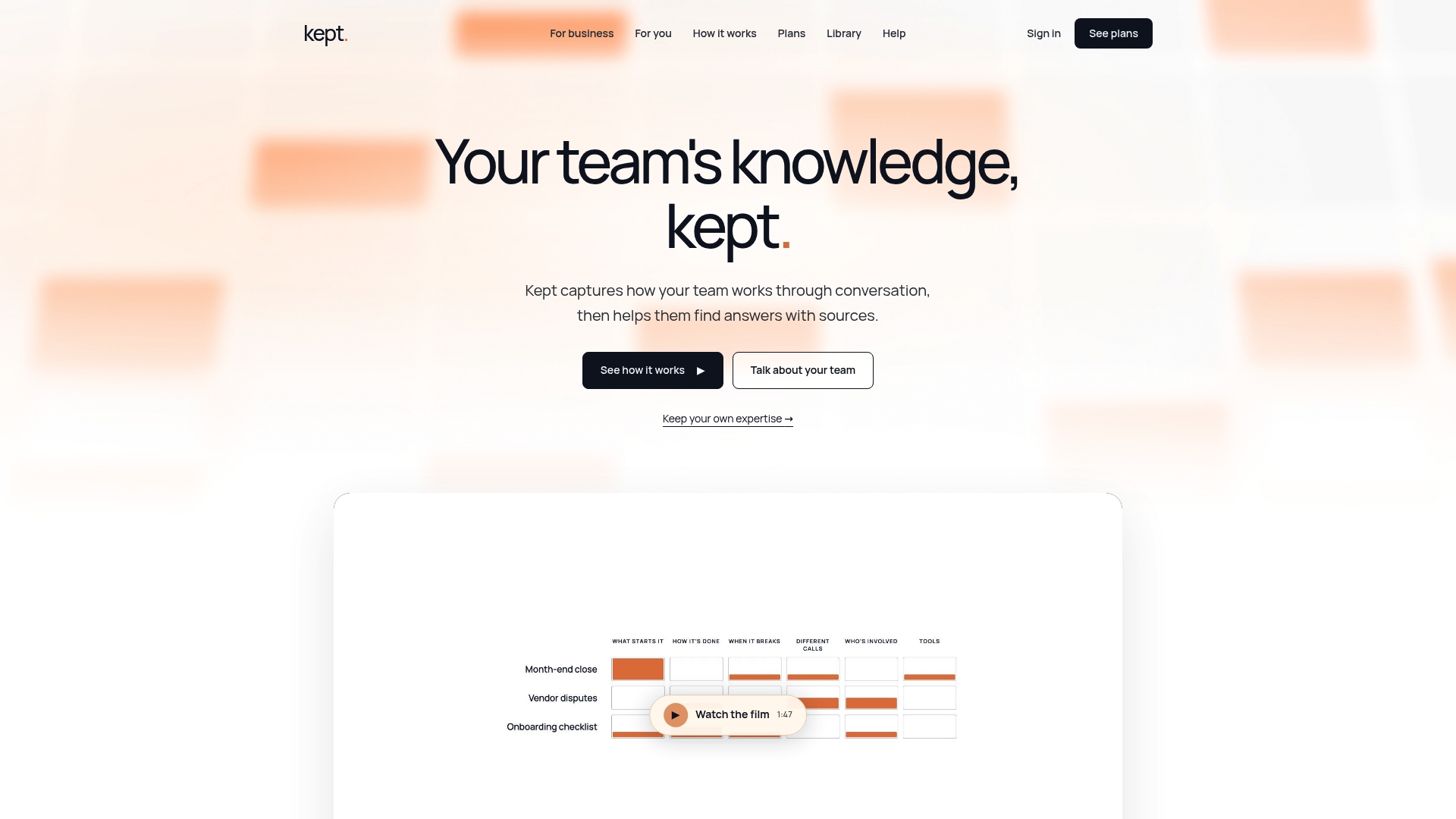
Building a lifecycle program from scratch, with interview scripts, taxonomy design, and a review cadence, takes real time most managers don't have. Kept shortens that path by turning guided conversation directly into structured, searchable workflow documentation, covering capture, codification, and retrieval in one step instead of three separate projects.
- Some solutions let individual professionals document their own expertise in guided sessions.
- Other solutions provide teams shared workspaces with access controls, so documented knowledge stays with the organization.
- Plans often support opt-in capture and deletion, so contributors keep control over what information is retained and what is not.
See current plans and pricing, or watch how it works for teams that can't afford to lose what one person knows at Kept for Business.
Sources
For deeper study, start with Managing the Knowledge Life Cycle from MIT Sloan on how knowledge matures across stages, ISO 30401:2018 for system-level governance requirements, and a KM maturity study linking maturity to delivery performance and retention. For a field-level view of documentation practice, see this construction documentation guide.
- ISO 30401:2018 - Knowledge management systems — Requirements
- Managing the Knowledge Life Cycle
- Knowledge management practices and KM maturity study (IJMEM)
FAQ
What is the knowledge management lifecycle?
The knowledge management lifecycle is the sequence a piece of organizational knowledge moves through: creation, capture, organization, sharing, application, and eventual update or retirement. Different stages call for different techniques, according to MIT Sloan's research on knowledge maturation.
What are the 5 C's of knowledge management?
Definitions of the "5 C's" vary across practitioners and sources. A common version covers creating, capturing, curating, communicating, and consuming knowledge, which lines up closely with the six-stage lifecycle described above minus explicit retirement.
What are the 5 pillars of knowledge management?
There's no single authoritative "5 pillars" framework; the term is used inconsistently across the field. The more reliable reference point is the ISO 30401:2018 standard, which frames knowledge management as a governed system rather than a fixed set of pillars.
What are the five stages of knowledge management?
Most practical models describe five or six stages: creation, capture and codification, organization and storage, sharing and distribution, application, and often a final update or retirement stage. The count varies by source, but the sequence from individual insight to organizational reuse stays consistent.